Showing posts with label Jamaica. Show all posts

8.17.2020

HAPPY BIRTHDAY MARCUS GARVEY

By Gloria Dulan-Wilson

Hello All:

We are living in some strange times.  Times that make you wonder what the heck is going on - it feels as if the entire world has lost its mind - we feel as though we're under siege by the forces of evil, and that God is likewise putting us through our paces for being so lazy, greedy, ignorant, unfaithful, and  just plain blind.  And when I we - I'm primarily talking about Black people - even though the entire world is in an uproar with the plandemic spreading throughout the world.

Today, August 17, is Marcus Garvey's birthday.  I wonder what he would do - what he would say - how he would lead- especially after over 100 years when he tried to get us out of a country that treated us like trash - like dirt under their boots - not like secondclass citizens - but like unwanted interlopers - even though they were the ones who kidnapped us from our homeland in the first place.

I've known about Garvey at least since I was 5 years old.  I heard about back to Africa.  I knew in my family he was sort of a legend.  I also knew that somehow or other we ended up not going back to Africa.  In our history classes, especially during Negro History Week, there was always some one in our class who made Garvey's speech UP YOU MIGHTY RACE - YOU CAN ACCOMPLISH WHAT YOU WILL.  Of course, at the time I had no idea that Garvey had a Jamaican accent.  I never thought that he was that attractive, as a kid, but I knew that he was powerful - because they were still talking about him decades after his death.  They talked about the parades, about the classes, about the businesses that were started from his teachings on independence; and about his flamboyant dress.  


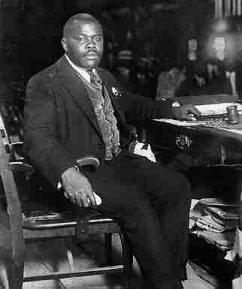
The Honorable Marcus Garvey Founder of the Universal Negro Improvement Association (UNIA)


However, it wasn't until I was in college that I truly began to have a deep appreciation for Garvey.  After having participated in civil rights activities as a child in Oklahoma since the age of 10, and having the push back by rednecks who didn't want us to eat, shop, entertain, or be educated with them, by the time I was 18, I had had enough and had decided that I was no longer participating in marches to integrate with whites.  It was then that I totally understood why he was trying to get us to move back to Africa and be in our own country, with our own people, our own government, and our own wealth and economy. 

As a student at Lincoln University (Black in the day), all seniors were required to submit a senior thesis and defend it in order to graduate. Mine happened to have been about W.E.B. DuBois and Marcus Garvey. I read their philosophies, biographies, writings, and news articles about them.  It was such a wonderful revelation because of so many things I learned through Garvey's own voice.
 
To my dismay, however,  I learned that W.E.B. DuBois was against Marcus Garvey, and was used as a tool by whites to try to paint Garvey as a charlatan. They even had front page articles in white news papers with DuBois putting Garvey's concepts and ideas down. This is deeply disturbing because of all the wonderful things he had written that I was required to read in High School in OKC. The irony of the whole thing was that Garvey was sabotaged by his white detractors who were hell bent on keeping Africans and African Americans form reuniting. He was falsely accused of mail fraud because Black people sent him money in the mail to purchase the ships that would transport them back to Africa. He purchased the ships - however, due to sabotage, they were unseaworthy. The rest is travesty and white hidstory. 
 
Ironically still, DuBois ended up expatriating to Africa - Ghana to be exact - when he began to be persecuted by the same whites who played on his ego and got him to denounce Garvey in the first place. He ended up apologizing for having been involved in the destruction of the BACK TO AFRICA MOVEMENT. Too little too late - and here we are - the descendants of 12 million Black Americans who were all ready to go home and reunite with their families - undermined by whites who had vested interests in the rape of Africa, and who wanted to retain us as their cheap labor force.
 
TODAY, AUGUST 17, 2020 IS MARCUS GARVEY'S 133rd BIRTHDAY ANNIVERSARY. 
 
My Grandmom was a Garveyite, as were many Oklahomans - there were many who were ready to pull up stakes, get out of this racist redneck environment and regroup in a country where their origins lie. There were many who were not. The bottom line is that we might have become the Wakanda depicted in the movie BLACK PANTHER, had we not been undermined. 
 
So,  we are still here!!   And how many can say that we have it any better  today than we did when Garvey first came here and tried to wake Black people up Black then? 
 
As you celebrate GARVEY'S BIRTHDAY ANNIVERSARY PLEASE MEDITATE ON WHAT WE WHO APPEAR TO BE STUCK HERE CAN DO TO MAKE OUR LIVES BETTER TOGETHER; AND HOW WE CAN ALSO JOIN WITH OUR BROTHERS AND SISTERS IN THE MOTHERLAND IN MAKING THEIR LIVES BETTER AS WELL. 
BLACK LIVES MATTER - 
AFRICA FOR THE AFRICANS, AT HOME AND ABROAD; 
WE ARE FAMILY! 
UP YOU MIGHTY RACE, YOU CAN ACCOMPLISH WHAT YOU WILL!!
 
There have been several pieces written about Garvey - much of them really don't do this wonderful brother justice. There is a filmstrip from History.com that is pure hogwash!! 
 
If you don't take the time to do your own homework, you will get the distorted version of this wonderful charismatic, genius who galvanized 12 MILLION BLACK PEOPLE without Instagram, FaceBook, TV - just his intelligence, love, fervor, and the courage to stand for what he believed. 
 
The link below is the closest i've come to contemporary information about all Marcus Garvey - the JAMAICAN BROTHER WHO WOKE AFRICAN AMERICANS UP!


http://nationalhumanitiescenter.org/tserve/twenty/tkeyinfo/garvey.htm


Marcus Garvey and the Universal Negro Improvement Association
David Van Leeuwen ©National Humanities Center
Links to online resources
Related info in
  "Getting Back to You"
Works cited


Marcus Garvey presiding at 1922 UNIA convention
Marcus Garvey presiding at the 1922 UNIA convention,
Liberty Hall, New York City
Courtesy The Marcus Garvey and UNIA Papers Project, UCLA
Marcus Garvey and his organization, the Universal Negro Improvement Association (UNIA), represent the largest mass movement in African-American history. Proclaiming a black nationalist "Back to Africa" message, Garvey and the UNIA established 700 branches in thirty-eight states by the early 1920s. While chapters existed in the larger urban areas such as New York, Chicago, and Los Angeles, Garvey's message reached into small towns across the country as well. Later groups such as Father Divine's Universal Peace Mission Movement and the Nation of Islam drew members and philosophy from Garvey's organization, and the UNIA's appeal and influence were felt not only in America but in Canada, the Caribbean, and throughout Africa.
Garvey's philosophy and organization had a rich religious component that he blended with the political and economic aspects.
Considering the strong political and economic black nationalism of Garvey's movement, it may seem odd to include an essay on him in a Web site on religion in America. However, his philosophy and organization had a rich religious component that he blended with the political and economic aspects. Garvey himself claimed that his "Declaration of Rights of the Negro Peoples of the World," along with the Bible, served as "the Holy Writ for our Negro Race." He stated very clearly that "as we pray to Almighty God to save us through his Holy Words so shall we with confidence in ourselves follow the sentiment of the Declaration of Rights and carve our way to liberty." For Garvey, it was no less than the will of God for black people to be free to determine their own destiny. His organization took as its motto "One God! One Aim! One Destiny!" and looked to the literal fulfillment of Psalm 68:31: "Princes shall come out of Egypt: Ethiopia shall soon stretch forth her hands unto God." 

Garvey was born in 1887 in St. Anne's Bay, Jamaica. Due to the economic hardship of his family, he left school at age fourteen and learned the printing and newspaper business. He became interested in politics and soon got involved in projects aimed at helping those on the bottom of society. Unsatisfied with his work, he travelled to London in 1912 and stayed in England for two years. During this time he paid close attention to the controversy between Ireland and England concerning Ireland's independence. He was also exposed to the ideas and writings of a group of black colonial writers that came together in London around the African Times and Orient Review. Nationalism in both Ireland and Africa along with ideas such as race conservation undoubtedly had an impact on Garvey.

However, he later remembered that the most influential experience of his stay in London was reading Booker T. Washington's autobiography Up From Slavery. Washington believed African Americans needed to improve themselves first, showing whites in America that they deserved equal rights. Although politically involved behind the scenes, Washington repeatedly claimed that African Americans would not benefit from political activism and started an industrial training school in Alabama that embodied his own philosophy of self-help. Garvey embraced Washington's ideas and returned to Jamaica in 1914 to found the UNIA with the motto "One God! One Aim! One Destiny!"

Initially he kept very much in line with Washington by encouraging his fellow Jamaicans of African descent to work hard, demonstrate good morals and a strong character, and not worry about politics as a tool to advance their cause. Garvey did not make much headway in Jamaica and decided to visit America in order to meet Booker T. Washington and learn more about the situation of African Americans. By the time Garvey arrived in America in 1916, Washington had died, but Garvey decided to travel around the country and observe African Americans and their struggle for equal rights.

What Garvey saw was a shifting population and a diminishing hope in Jim Crow's demise. African Americans were moving in large numbers out of the rural South and into the urban areas of both North and South. As World War One came to an end, disillusionment was beginning to take hold. Not only was the optimism in the continuing improvement of humanity and society broken apart, but so was any hope on the part of African Americans that they would gain the rights enjoyed by every white American citizen. African Americans had served in large numbers in the war, and many expected some kind of respect and acknowledgment that they too were equal citizens. Indeed, World War One was the perfect opportunity for African Americans to fulfill Booker T. Washington's requirement for equality and freedom. Through dedicated service in the armed forces, they could prove their worth and show they deserved the same rights as whites. However, as black soldiers returned from the war, and more and more African Americans moved into the urban areas, racial tensions grew. Between 1917 and 1919 race riots erupted in East St. Louis, Chicago, Tulsa, and other cities, demonstrating that whites did not intend to treat African Americans any differently than they had before the war.

After surveying the racial situation in America, Garvey was convinced that integration would never happen and that only economic, political, and cultural success on the part of African Americans would bring about equality and respect. With this goal he established the headquarters of the UNIA in New York in 1917 and began to spread a message of black nationalism and the eventual return to Africa of all people of African descent. His brand of black nationalism had three components—unity, pride in the African cultural heritage, and complete autonomy. Garvey believed people of African descent could establish a great independent nation in their ancient homeland of Africa. He took the self-help message of Washington and adapted it to the situation he saw in America, taking a somewhat individualistic, integrationist philosophy and turning it into a more corporate, politically-minded, nation-building message.

In 1919 Garvey purchased an auditorium in Harlem and named it Liberty Hall. There he held nightly meetings to get his message out, sometimes to an audience of six thousand. In 1918 he began a newspaper, Negro World, which by 1920 had a circulation somewhere between 50,000 and 200,000. Membership in the UNIA is difficult to assess. At one point, Garvey claimed to have six million members. That figure is most likely inflated. However, it is beyond dispute that millions were involved and directly affected by Garvey and his message.

To promote unity, Garvey encouraged African Americans to be concerned with themselves first. He stated after World War One that "[t]he first dying that is to be done by the black man in the future will be done to make himself free. And then when we are finished, if we have any charity to bestow, we may die for the white man. But as for me, I think I have stopped dying for him." Black people had to do the work that success and independence demanded, and, most important, they had to do that work for themselves. "If you want liberty," claimed Garvey to a meeting held in 1921, "you yourselves must strike the blow. If you must be free, you must become so through your own effort."

But Garvey knew African Americans would not take action if they did not change their perceptions of themselves. He hammered home the idea of racial pride by celebrating the African past and encouraging African Americans to be proud of their heritage and proud of the way they looked. Garvey proclaimed "black is beautiful" long before it became popular in the 1960s. He wanted African Americans to see themselves as members of a mighty race. "We must canonize our own saints, create our own martyrs, and elevate to positions of fame and honor black men and women who have made their distinct contributions to our racial history." He encouraged parents to give their children "dolls that look like them to play with and cuddle," and he did not want black people thinking of themselves in a defeatist way. "I am the equal of any white man; I want you to feel the same way."

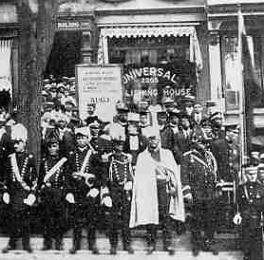
Garvey organized his group in a way that made those sentiments visible. He created an African Legion that dressed in military garb, uniformed marching bands, and other auxiliary groups such as the Black Cross Nurses.
Marcus Garvey with UNIA leaders, 1922 UNIA convention
Marcus Garvey with Potentate Gabriel M. Johnson of Liberia, Supreme Deputy G.O. Marke of Sierra Leone, and other UNIA leaders review the parade opening the 1922 UNIA convention,
New York City
Courtesy The Marcus Garvey and UNIA Papers Project, UCLA
He was elected in 1920 as provisional President of Africa by the members of the UNIA and dressed in a military uniform with a plumed hat. At the UNIA's First International Convention in 1920, people lined the streets of Harlem to watch Garvey and his followers, dressed in their military outfits, march to their meeting under banners that read "We Want a Black Civilization" and "Africa Must Be Free." All the pomp brought Garvey ridicule from mainstream African-American leaders, but it also served to inspire many African Americans who had never seen black people so bold and daring.

While racial pride and unity played important roles in Garvey's black nationalism, he touted capitalism as the tool that would establish African Americans as an independent group. His message has been called the evangel of black success, for he believed economic success was the quickest and most effective way to independence. Interestingly enough, it was white America that served as a prime example of what blacks could accomplish. "Until you produce what the white man has produced," he claimed, "you will not be his equal." In 1919 he established the Negro Factories Corporation and offered stock for African Americans to buy. He wanted to produce everything that a nation needed so that African Americans could completely rely on their own efforts. At one point the corporation operated three grocery stores, two restaurants, a printing plant, a steam laundry, and owned several buildings and trucks in New York City alone. His most famous economic venture was a shipping company known as the Black Star Line, a counterpart to a white-owned company called the White Star Line. Garvey started the shipping company in 1919 as a way to promote trade but also to transport passengers to Africa. He believed it could also serve as an important and tangible sign of black success. However the shipping company eventually failed due to expensive repairs, mismanagement, and corruption.

With all his talk of a mighty race that would one day rule Africa, it would have been foolish for Garvey to underestimate the power of religion, particularly Christianity, within the African-American community. The churches served as the only arena in which African Americans exercised full control. Not only did they serve as houses of worship but also as meeting places that dealt with social, economic, and political issues. Pastors were the most powerful people in the community for they influenced and controlled the community's most important institution. Garvey knew the important place religion held, and he worked hard to recruit pastors into his organization. He enjoyed tremendous success at winning over leaders from almost every denomination. One of those clergymen, George Alexander McGuire, an Episcopalian, was elected chaplain-general of the UNIA in 1920. McGuire wrote the UNIA's official liturgy, the "Universal Negro Ritual" and the "Universal Negro Catechism" that set forth the teachings of the UNIA. He attempted to shape the UNIA into a Christian black-nationalist organization. Garvey, however, did not want the organization to take on the trappings of one particular denomination, for he did not want to offend any of its members. McGuire left UNIA in 1921 to begin his own church, the African Orthodox Church, a black-nationalist neo-Anglican denomination that kept close ties with the UNIA.

The UNIA meetings at Liberty Hall in Harlem were rich with religious ritual and language, as Randall Burkett points out in his book Black Redemption: Churchmen Speak for the Garvey Movement. For even though Garvey rejected McGuire's effort to transform the UNIA into a black-nationalist Christian denomination, he blended these two traditions in his message and in the form of his UNIA meetings. A typical meeting followed this order:
  • The hymn "Shine On, Eternal Light," written specifically for the UNIA by its music director
  • A reading of Psalm 68:31: "Princes shall come out of Egypt: Ethiopia shall soon stretch forth her hands unto God."
  • The official opening hymn "From Greenland's Icy Mountains," stating a commitment to the Christianization of Africa
  • Recitation of the official motto, "One God! One Aim! One Destiny!"
  • "The Lord's Prayer" and other prayers spoken by the chaplain
  • A sermon or some brief remarks
  • The business meeting
  • The closing hymn, either "Onward Christian Soldiers" or the UNIA's national anthem, the "Universal Negro Anthem."
Garvey's black nationalism blended with his Christian outlook rather dramatically when he claimed that African Americans should view God "through our own spectacles." If whites could view God as white, then blacks could view God as black. In 1924 the convention canonized Jesus Christ as a "Black Man of Sorrows" and the Virgin Mary as a "Black Madonna." Garvey used that image as an inspiration to succeed in this life, for African Americans needed to worship a God that understood their plight, understood their suffering, and would help them overcome their present state. Garvey was not interested in promoting hope in the afterlife. Success in this life was the key. Achieving economic, cultural, social, and political success would free African Americans in this life. The afterlife would take care of itself. Perhaps Garvey's greatest genius was taking that message of material, social, and political success and transforming it into a religious message, one that could lead to "conversion," one that did not challenge the basic doctrines of his followers but incorporated them into the whole of his vision. One of Garvey's top ministers gave witness to the powerful effect of that message when he claimed in 1920, "I feel that I am a full-fledged minister of the African gospel."

Garvey's message of black nationalism and a free black Africa met considerable resistance from other African-American leaders. W.E.B. DuBois and James Weldon Johnson of the NAACP, and Chandler Owen and A. Philip Randolph of the publication Messenger, had their doubts about Garvey. By 1922 his rhetoric shifted away from a confrontational stance against white America to a position of separatism mixed with just enough cooperation. He applauded whites who promoted the idea of sending African Americans back to Africa. He even met with a prominent leader of the Ku Klux Klan in Atlanta in 1922 to discuss their views on miscegenation and social equality. That meeting only gave more fuel to his critics. In 1924 DuBois claimed that "Marcus Garvey is the most dangerous enemy of the Negro race in America and in the world." Owen and Randolph, whose paper saw the race issue as one of class more than skin color, called Garvey the "messenger boy of the Klan" and a "Supreme Negro Jamaican jackass" while labeling his organization the "Uninformed Negroes Infamous Association." The federal government also took an interest in Garvey and in 1922 indicted him for mail fraud. He was eventually sentenced to prison and began serving his sentence in 1925. When his sentence was commuted two years later, Garvey was deported to Jamaica. With his imprisonment and deportation, his organization in the United States lost much of its momentum. Garvey spent the last years of his life in London and died in 1940.

Guiding Student Discussion

In my experience with undergraduates, I find that students know little if anything about Marcus Garvey. The simplest way to get their attention is to tell them that Garvey's UNIA was bigger than the Civil Rights Movement, which most of them do know something about. Telling them that Garvey's influence extended well beyond the borders of the United States to the Caribbean, Canada, and Africa may also pique their interest. Pointing out that Garvey's message had a tremendous influence on later groups such as the Rastafarians and the Nation of Islam is also important. Much of what he said concerning racial pride and the potential for great racial success can be heard in later figures such as Malcolm X and even Stokely Carmichael, leader of SNCC (Student Non-Violent Coordinating Committee). Garvey, Malcolm, and Carmichael are all considered more radical than the mainstream civil rights protesters, yet it was Booker T. Washington, someone considered quite conservative by most scholars, who had a profound influence on Garvey. Exploring that connection between the accommodationist philosophy of Washington and the black nationalism of Garvey and the other leaders might generate the most interest and help the students see the important place that Garvey holds in American history.

You might also bring up Garvey's insistence that African Americans should see God, Jesus, and Mary as black. What is Garvey trying to do here? Why not throw out the religion of Christianity, which was used as a rationale for keeping slaves and viewing blacks as inferior people, and form a new religion that could communicate the hopes and desires of people of African descent? Why not do as the later group, the Nation of Islam, and remove all white influence? You might talk about Christianity itself, how blacks identified with so many of the stories of the Bible, the people of Israel, the suffering of Jesus, and how African American's understanding of Christianity in many ways may already have been "black." You might also talk about the role religion plays in a group such as Garvey's. Why is religion so important here; why does it play any role at all? Why couldn't Garvey simply preach black nationalism in economic, political, and social terms? What does religious expression do for people in an organization like the UNIA?

Historians Debate

Scholars have debated the influence and relevance of Garvey, with assessments ranging from Garvey as little more than a demagogue whose uniqueness points to his irrelevance, to Garvey and his organization as earlier embodiments of the political battles of the 1960s. This debate is partly due to the fact that, until quite recently, sources for any study of the Garvey movement were difficult to obtain. Many were destroyed when the government deported Garvey, and some were lost in the air raids in London where Garvey spent the last years of his life.

E. David Cronon's Black Moses: The Story of Marcus Garvey and the Universal Negro Improvement Association (1969) is an example of a more negative assessment of Garvey. Tony Martin's Marcus Garvey, Hero: A First Biography (1983) and Race First: The Ideological and Organizational Struggle of Marcus Garvey and the Universal Negro Improvement Association (1976), along with Theodore Vincent's Black Power and the Garvey Movement (1971) are much more positive about Garvey and his influence. Vincent provides some valuable information about later groups that were influenced by Garvey. For example, Elijah Poole, later known as Elijah Muhammed, was a Garveyite in Chicago and later became leader of the Nation of Islam. Judith Stein in The World of Marcus Garvey: Race and Class in Modern Society (1986) attempts to occupy some middle ground in the debate, not seeing Garvey and the UNIA as a precursor to the politics of the 1960s but also not dismissing Garvey as irrelevant. 

An article that present a good summary of Garvey and his movement is Lawrence Levin's "Marcus Garvey and the Politics of Revitalization" in Black Leaders of the Twentieth Century, edited by John Hope Franklin and August Meier (1982). For the religious aspects of the Garvey movement in the United States, look to Randall K. Burkett's Black Redemption: Churchmen Speak for the Garvey Movement (1978) and Garveyism as a Religious Movement: The Institutionalization of a Black Civil Religion (1978).

The most important contribution to studies on Garvey is Robert A. Hill's The Marcus Garvey and Universal Negro Improvement Association Papers (1983). Hill essentially brought the Garvey archive together by traveling the world and collecting every piece of paper he could find that had something to do with Garvey. He covers the UNIA's activity in the United States, the Caribbean, and Africa. He explores the influence of Ireland and its struggle for independence on Garvey's thinking and suggests that New Thought may have had some influence on Garvey as well. His general introduction and his more specific introduction, which are available online (see links) are outstanding and provide a concise summary of Garvey and the UNIA.

Just so you'll know, I deliberately reprinted the entire article on Garvey - it's well written but still much too abbreviated to give a true sense of what he really stands for.  

If you read this much, you'll be much farther ahead than most.  I urge you to get hold of his book and really study this wonderful, charismatic genius and Black activist.   

It's amazing to me still how he was able to galvanize millions of Black people when in today's world we're hard pressed to get 3 Black people to stick together.  It appears to me that we need to stop being so smug about our contemporary world and give credit to this great Black man.  More importantly, we would do well to study and inculcate his philosophies and methodologies.  We might just begin to develop the unity and autonomy we need to move our people forward.

Again HAPPY BIRTHDAY TO MARCUS GARVEY - THANKS SO MUCH FOR ALL YOU DID FOR BLACK PEOPLE.

NOW THAT YOU KNOW
WHAT ARE YOU GOING TO DO ABOUT IT?

Stay Blessed & 
ECLECTICALLY BLACK 


-->

10.22.2015

Open Letter to Britain from former Jamaica PM Patterson: When do we get an apology and our reparations for British Slavery?

By Gloria Dulan-Wilson

Hello All:

This is of extreme importance to us all, whether we're from the Caribbean, have relatives there, or even more significant, we are people of African ancestry and heritage.  My friend, K. Mensah Wali, sent this to me, and think it must be shared - because we have to begin to demand reparations for all Black people the world over - whether in the US, the Caribbean, Africa, South America - We can no longer bite our tongues, and dig our toes in the sand, and walk around with hat in hand and hope these miscreants will repay us for the trauma we suffered, the losses we incurred, and the work we've done (remember the song by the Staple Singers:  WHEN WILL WE BE PAID FOR THE WORK WE'VE DONE?")

So check this out - and I'm posting it in its entirety.  

Stay Blessed & 
   ECLECTICALLY BLACK

   Gloria  


Ex Jamaican PM pulls no punches in response to British leader on slavery 

pj-patterson-740KINGSTON, Jamaica, Tuesday October 13, 2015 – Are we not worthy of an apology, or less deserving?
That was the question former Jamaica prime minister PJ Patterson posed in an open letter to UK Prime Minister David Cameron who visited the island recently, following the Brit leader’s failure to apologize for his country’s role in the slave trade and his suggestion that Caribbean countries should put the injustices of slavery behind them and move on.
Cameron’s comments also followed calls from Jamaican Prime Minister Portia Simpson-Miller for the UK to discuss the issue of reparations in “a spirit of mutual respect, openness and understanding”.
As he announced a package of over £360 million (US$545.8 million) of bilateral aid for the region, the British leader acknowledged that slavery is abhorrent in all its forms and “Britain is proud to have eventually led the way in its abolition”.
But he made it clear that reparations was not on his agenda: “That the Caribbean has emerged from the long, dark shadow it cast is testament to the resilience and spirit of its people. I acknowledge that these wounds run very deep indeed. But I do hope that, as friends who have gone through so much together since those darkest of times, we can move on from this painful legacy and continue to build for the future.”
But Patterson was adamant that the mere acknowledgement of the horror of slavery would not suffice.
“It was and still is a most heinous crime against humanity — a stain which cannot be removed merely by the passage of time. Those who perished in the Middle Passage and the fatal victims on the sugar plantations were the victims of genocide. This is a crime in accordance with international law,” he said.
“You have refused to apologize. Yet your Government has apologized to everyone else for horrid crimes. Are we not worthy of an apology or less deserving?
“The international community and international law call for formal apologies when crimes against humanity are committed. The UN has deemed slave trading and slavery as crimes against humanity. The refusal to apologize is a refusal to take responsibility for the crime. In a law-abiding world this is not acceptable,” he added.
The former prime minister said those affected by the slave trade could not simply forget and move on if there is no explicit admission of guilt.
“Where is the prior confession that Britain fashioned, legalized, perpetuated and prospered from the slave trade?
Indeed, the facts speak to a different explanation. In Jamaica, the enslaved led by Sam Sharpe tried to abolish slavery themselves three years before your Parliament acted. The British Army destroyed these freedom fighters and executed their leaders.
This attempt to destroy the seed of freedom and justice in Jamaica continued for another 100 years. In 1865, the peasants sought to occupy Crown lands in order to survive widespread hunger. The British Government sent in the army and massacred those people, executing Paul Bogle, George William Gordon and other leaders.
Furthermore, the British Act of Emancipation reflected that the enslaved people of Jamaica were not human, but property. The 800,000 Africans in the Caribbean and elsewhere were valued at £47 million. The government agreed to compensate the slave owners £20 million, and passed an Emancipation Act, in which the enslaved had to work free for another four to six years in order to work off the £27 million promised slave owners. It was they who paid for their eventual freedom.
The enslaved paid more than 50 per cent of the cost of their market value in compensation to slave owners. This is what your Emancipation Act did. The enslaved got nothing by way of compensation. The Act of Emancipation was self-serving and was designed to support British national commercial interests alone.
Patterson added that it was precisely because “we all want to move on that the reparatory justice movement is alive and growing”.
“We all want to move on, but with justice and equality,” he contended.
“Contrary to your view, the Caribbean people will never emerge completely from the long, dark shadow of slavery until there is a full confession of guilt by those who committed this evil atrocity. The resilience and spirit of its people is no ground to impair the solemnity of a privileged parliamentary occasion and allow the memory of our ancestors to be offended once again.”
Cameron has also been chastised for his comments by American actor and civil rights activist Danny Glover, who was in Jamaica last week.
He said the British leader showed “his ignorance” by suggesting that descendants of slave simply put the atrocity behind them and get on with their lives.
Read PJ Patterson’s letter here.


Don Rojas,
Director of Communications,
Institute of the Black World 21st Century (IBW),
51 Millstone Road,
Randallstown, MD 21133


10.25.2014

OCTOBER 25: Celebrating Lou Wilson of MANDRILL's 73rd Birthday Anniversary - Peace and Love Be Unto Him

By Gloria Dulan-Wilson


HAPPY BIRTHDAY LOU WILSON Tall, Dark & Chocolate!

Well, it's here again, and I'm in a lot better space this year than I was last year - Lou's birthday is today, Saturday, October 25, 2014 - and, though I was a basket case leading up to this occasion, I've actually walked through the valley and come out on the other side in a much better space - emotionally, spiritually, psychologically, mentally and even physically than I went in.  

LOU & GLO WILSON


Truth be told, I spent the better part of this week tripping on how I was going to handle October 25 without him being here - without surprising him with at least 3 zany birthday greeting cards (I could never ever choose just one); without all the silly, mushy stuff we said to each other.  So as it got closer and closer to the date,  I allowed myself to wallow in the blues for the past few days - literally - and when I say wallow, I mean I wallowed.  I bawled, I cried, I sobbed, I prayed, I vividly relived all the treasured times we spent together - all the agonizing times we spent apart.  I looked him in the eyes and traveled all the way back to the first time we met at Temple University's McGonigle Hall (in Philadelphia) -  all the way to January 5, the date of our the last conversation we had about travel plans and moving arrangements. I remember reminding him that it was our grandson's birthday (as if he would forget that!), and laughing at how fast time was whizzing by.

I literally went through all the  agonizing "why me?" "it's not fair"  moments.  I think it's what most of us call the blues - and I had it soooo bad, I didn't come outside for two days!!!

And just when I thought that I would surely cry my eyeballs out, I felt the most amazing aura of peace and love I'd ever experienced in my life come over me and permeate the room.  And I heard Israel Houghton's song:  "It's Not Over," in my mind - as if he and New Breed had just stepped into the room and started singing, as if to tell me that everything was gonna be okay; and this was not going to be ongoing pain, but the end of pain, which was now transformed into treasured moments.   

It was if God had just stepped into the room and said it's time to come out of the valley and move forward ("Moving Forward" by EH).  I sat on the edge of the bed and started smiling into the darkness, as I heard him say, "Hey Glo, between you, me, and the what? Lamp post - the lamp post can't talk; it tells no secrets - so really between you and me, we had a wonderful time here; we did a lot of things - they are all in here; that's what really matters. Right?  It's time for you to get up and get your glow back." 

So as I celebrate Lou, I honor all that we shared, and what we were able to complete in our walk together.  I take all that I've learned from him -  all those wonderful 3:00AM conversations and thank him for the blessings, the fun, the lessons - and yes, the trials and tribulations we went through to get to the point of reunion and resurrection before his transition.    I can now smile and listen to his music with enjoyment; I can  remember the times he spent over that Fender Rhodes picking out the lyrics for a new song that suddenly struck him; or recording into the tape recorder a sound that he wanted to inculcate into a new song idea that struck him;  impromptu jam sessions at the hotels where we stayed while on the road; or pulling out the old classic crooners like Johnny Hartman,  Latin vocalists and others that he so admired to go over why they were great.   (He loved Joe Cocker - I could never understand that one); revered the Beattles (I learned to enjoy them too) - and we both were comedy nuts - from Richard Pryor and Bill Cosby and Saturday Night Live and beyond.

Fiercely proud of his Caribbean heritage - Jamaican Dad, Barbadian Mom, born in Panama (Jamaica/Basha/Manian man), he would start the day playing Sparrow, Lord Kichener, and all the others he'd grown up listening to in Panama and Brooklyn.  All that culture and music was infused into this wonderful 6'4" giant, and he embraced it all - and melded it into his new found cultural base as an African American Caribbean brother from Bed Stuy.

I'm rejoicing that his genius has been passed through our DNA to our children and their children, and that it's blossoming in them in so many wonderful ways - not necessarily as musicians, but as wit and wisdom; masters of humor and conversation; outgoing, friendly, warm hearted generosity.  I have come to realize that Lou may have made his transition to the ancestors, but he's not dead - because he lives in each one of his children; he lives in that great body of music he gave to the world via MANDRILL - a great deal of which is still sitting on tapes in his brother's garage.  He may have even lent some of his DNA to his nieces and nephews - via his words of wisdom, his love of children, his love of education was transmitted to them every chance he had to be with them. 

Celebrating the Birthday of Lou Wilson of Mandrill:

Saturday, October 25, 2014, marks the 73rd Birthday of Lou Wilson, the love of my life.  It's been a challenge to make it through the month of October with so many memories and realizing that his Birthday will soon be here, but he won't be here to celebrate it with us.  Birthdays are a big deal in our family and it would usually be planning some way to surprise, shock and awe each other with some outlandish gift or homage.  But now, I'm dealing with the memories, the fun, our beautiful children - Kira, Rais & Adiya; our fantastic grandchildren - His brothers: Ric (Doc), Carlos (Carl), Wilfredo (Wolf) = the Group; and his wonderful parents Doris & Wilfred Wilson, and his kid brother Alonzo, who made their transitions before him - All that went to make up this wonderful, creative, talented, big hearted, complex Fine Black Man. He exuded music; his life was one long series of lyrics.  So Happy Birthday Lou Wilson (Tall/Dark&Chocolate)  - I celebrate you and the joy you brought to so many of us while you were here among us, and the treasured memories while you are with the Ancestors - Say hello to Gil Scott-Heron, Mom & Dad (yours and mine); Jitu Weusi, Amiri and all our friends.  I know you're all having a blast.

- Love You Always -

Stay Blessed -

GloW
LOU, CARLOS, RIC, WILFREDO


LOU WILSON BLACK IN THE DAY


Stay Blessed & 
       ECLECTICALLY BLACK 
       Gloria Dulan-Wilson


-->

8.27.2014

EVENT ALERT: Brooklyn Boro Pres Eric Adams Presents Go Caribbean! International Business and Investment Expo

By Gloria Dulan-Wilson

Brooklyn Borough President, Eric Adams to host Go Caribbean! International Business and  Investment Expo
 

BROOKLYN BOROUGH PRESIDENT ERIC ADAMS


Brooklyn Borough President, Eric Adams will be hosting a 2-day inaugural event, Go Caribbean!, scheduled for Monday, September 22nd and 23rd, at the Brooklyn Marriott.

This is the ideal forum for entrepreneurs, financiers, high net-worth individuals, government agencies and other business entities seeking investment or commercial opportunities with Caribbean businesses across the Caribbean region and North America.  The Expo will focus on industries with high growth potential - Information Technology, Agribusiness, Energy, and Media & Entertainment and Infrastructure.  The organizers are expecting over 1,500 attendees and over 100 exhibitors.

The event, themed, “Raising the Tide” is centered on Diaspora engagement, trade and investment.  The conference will feature presentations, workshops, networking forums and a variety of opportunities to promote Caribbean businesses globally.  Caribbean dignitaries, industry stalwarts, local and international government representatives will lead panel discussions on, “Financing,” “Innovation”, “Commercialization (Export Readiness),” and “Sustainability” for Caribbean-led businesses.

“Go Caribbean! is a long overdue platform.  This event is about unlocking the Caribbean’s value through the leveraging of global connections”, said Mr. Kevin Howell, President of Anchor Strategy Group and organizer of Go Caribbean!.  “Individuals, entrepreneurs or business owners seeking to sell goods or services and access financing,  or want to find out the do’s and don’ts of import/export between the Caribbean and the U.S. , will find answers, partners or networking opportunities at the conference”, he concluded.

Expo speaker include Fitzgerald Miller,  Director of Investments Openheimer & Co; David Mullings,  Managing Partner Real Vibez, Inc. & CEO of Keystone Augusta, Inc.; Tilokee Depoo, Dean & Professor of Management School of Business Metropolitan College of New York; David Panton, Partner Navigation Capital Partners; Regina Gordin, Regional Director Eastern Region EXIM Bank; Neil Lowe, Managing Partner of GCHUS; K.Milele “Kiki” Peterson; Celebrity Fashion Veteran;  Michael Bentt Award Winning Actor and Boxing Champion;  Dr. Joseph Batiste, Chairman of National Association for Advancement of Haitians; and Ambassadors of Trinidad & Tobago, Dominica and The Bahamas, among others.


Go Caribbean! International Business and Investment Expo

Monday, September 22, 2014 at 9:00 AM - Tuesday, September 23, 2014 at 2:00 PM (PDT)

Ticket Information

Ticket Type Sales End Price Fee Quantity
Conference Package Ticket: Promotion Tickets - VIP Luncheon, VIP Reception and All Day Seminar   more info 1d 12h 46m $189.00 $11.39
Full Day Seminar and Training - Access to 15 Session Sep 21, 2014 $100.00 $6.49
General Expo Attendees - September 22, 2014 Sep 22, 2014 $0.00 $0.00
Business Super Special (10x10 Booth, 1/2 Page Color Journal Ad, 2 VIP Luncheon Ticket, 2 VIP Reception Ticket) - September 22, 2014
10x10 Booth 1/2 Page Color Journal Ad 2 VIP Luncheon Ticket 2 VIP Reception Ticket
Aug 31, 2014 $1,100.00 $42.95
Conference Special (All Day Workshops, 1 VIP Luncheon and 1 VIP Reception Ticket) - September 22, 2014   more info 2d 18h 46m $200.00 $5.99
Exhibitors - Small Businesses - September 22, 2014
10 x 10 Booths 1 VIP Reception Ticket
Aug 31, 2014 $500.00 $24.95
Conference Package Ticket: Promotion Tickets - VIP Luncheon, VIP Reception and All Day Seminar   more info Ended $160.00 $9.79 N/A

Event Details

GO-CARIBBEAN! International Business and Trade Expo will facilitate the convergence of entrepreneurs, financiers, high net-worth individuals and strategic partners focused on the development and support of Caribbean business across the region and in North America.  It is a place to meet and learn about new business trends, discuss best practices and identify opportunities to increase investment in the Caribbean and for Caribbean businesses in the Diaspora.

Highlights


  • Increase the diaspora’s commitment to Caribbean investment through an increased dialogue around opportunities in the region
  • Align new Caribbean companies with venture capitalist and private equity firms internationally
  • Champion meetings that will lead to key strategic partnerships with Caribbean based businesses and enhance multi-national, multi-lateral and global cooperation 
  • Provide training to Caribbean delegates around trade and investments in North America and similarly to the Diaspora about the Caribbean markets 
  • Facilitate the development of an active cluster of entrepreneurs on both sides through greater access to funding and knowledge of the international markets 
    • Strengthen the visibility of Caribbean owned business in United States and Canada
Target Industries
For the inaugural expo the GO-CARIBBEAN! will focus on the traditional and emerging high profile Caribbean industries. The selected sectors are:  
  • Information and Communication Technology (Call Center, E-Medicine, Software Development, etc.) 
  • Food & Beverage – (Manufacturing and Packaging) 
  • Energy – (Oil, Alternative Energy - Solar, Wind & Geothermal) 
  • Construction and Infrastructure 
  • Creative Services: Sports & Entertainment 
  • Tourism (Medical Tourism: Spa & Wellness and Infrastructure Development)
Target Attendees
GO-CARIBBEAN! anticipates approximately 3,000 attendees and 250 exhibitors from across the Caribbean and North America. Exhibitors include corporations, government agencies from the North America and the Caribbean, International Funding and Trade Agencies and Caribbean Affinity Groups.
Key Partners
  • Caribbean Tourism Organization
  • Institute of Caribbean Studies
  • Caribbean Association of Industry & Commerce
  • Caribbean Business Connections
  • Brooklyn Borough President 
  • Consul General Corp 
  • Caribbean Churches in the  New York City  Tristate
  • Private Sector and Investment Organization in Various Caribbean Islands
Have questions about Go Caribbean! International Business and Investment Expo? Contact Anchor Strategy Group and Go Caribbean!
Save This Event
27 people have saved this

When & Where


New York Marriott at the Brooklyn Bridge
333 Adams St
New York, New York 11201

Monday, September 22, 2014 at 9:00 AM - Tuesday, September 23, 2014 at 2:00 PM (PDT)


  Add to my calendar

Organizer

Anchor Strategy Group and Go Caribbean!

Go Caribbean! is the brainchild of Anchor Strategy Group (“Anchor”), a New York based consulting firm. Anchor was established in 2009 to design integrated management solutions and position clients in the private sector and government agencies across the Caribbean Diaspora and Caribbean Basin to seize new business opportunities and strategic goals.  Key services provided by Anchor include:
  • Project Financing Assistance
  • Business Management Training
  • Product Placement for both US and Caribbean Companies
  • Strategic Relationship Brokering
  • Economic Development Research

For further information, contact Kevin Howell at khowell@anchorsllc.com or 347.413.3282.

  Contact the Organizer


-->

8.05.2013

Happy Birthday to My Handsome Son Rais "One Sun Lion RA" Wilson

by Gloria Dulan-Wilson

HAPPY BIRTHDAY HANDSOME SON!!! 

Rais & Big Sister Kira

   You know I had to do this - this is a milestone birthday, and I just couldn't let it pass without paying homage to my handsome son, Rais Enaharo Wilson (his name is both East and West African).  Based on the fact that he's a Leo, Rais means Ruler; Enaharo means Like the Sun (since Leo is a Sun King).  He later amended it to a stage name of his chosing:  The One Sun Lion RA. 

    Spoken word artist, musician in his own right, and the pride and joy of his late father, Lou Wilson (Mandrill), Rais has stepped out in his own right and begun blazing his own trail in the world of entertainment.

    As a kid, sandwiched in between two sisters, Kira and Adiya, Ra made it plain that he was definitely the "boss" in the family - that is until his big sister shut him down, or his little sister put on a pouty face.  There was the usual amount of sibling rivalry, but for the most part, these three were each other's support system, and continue to be so to this day.  A lot of love in our family for each other.  I am so proud of that fact. 

    Now that they are all grown up, mature adults, and RA is the father of three beautiful chocolate drops of his own, it's a pleasure to see him with his kids, telling them the exact thing I told him when he was little:  "Don't sit with your mouth open;" " say please," "say thank you," "say excuse me," "take your elbows off the table," "don't talk with your mouth full" "Black is Beautiful and so are you," "I love you."

    A consummate musician, writer, poet, and artist, Rais often appeared with his dad's group, Mandrill, on tour, performing some of his own original work.  He's also appeared with Roy Ayers in the past. 

    As a child it was easy to see he had a lot of talent, because he drove his teachers crazy.  As a result of being frequently called to the school because he was always cracking jokes or imitating (perfectly) characters he had seen on TV or his teachers;  I finally told him the only way he could do that and it not be a problem, was if he was getting paid.  So I made it mandatory for him to audition for plays and roles, got him an agent, Sassie Gehrhardt, who got him on two Cosby Shows, and nearly landed him a role as Vanessa's love interest.  In addition, he performed in two plays at the Harlem School of the Arts, one in which Susan Taylor's daughter, Shauna (?) danced (Wings Over Harlem, and We Don't Mean Chicken Honey). 

    My Handsome Son - I do love saying that - is his own person, but he shares so many traits from both the Dulan and Wilson family lines.  I've taken to calling my children Jamaica/Baja/Manian/Indians - because of their family lineages of Jamaica, Barbados, Panama and Cherokee nations.  It's beautiful to see the blends in his talent, temperament, expression, and genetic code. 

    As an artist, his work has been displayed at Yale University, Danny Simmons Studio, and in Paris.  Being multitalented has its blessings, and its frustrations; but the dedication with which he's followed his dream is beginning to bear fruit. 

RA Black in the Day at North Carolina A&T
      And on this milestone of Birthdays, August 5, 2013, I am speaking power over my son and his life, and declaring that he will have many more wonderful days ahead of him.  He is blessed and highly favored.  And very much loved by us all. 

Stay Blessed &
ECLECTICALLY BLACK
Momi

-->