Showing posts with label Africa. Show all posts

4.26.2022

Guest Post: Response by Gene Dinizulu Tinnie Africans Must Trade With Themselves

By Gloria DULAN-Wilson
Hello All!

Whenever one of our Brothers or Sisters says or does something profound, positive that will be of benefit to us all, I try to post it in my blog, along with any additional salient points.  These are brilliant points or concepts that don't make the mainstream media, or, as Rev. Michael Beckwith calls it, "Paid advertisement masquerading as the news."   You know what I mean - the kind of bogus journalism that spends the first 10 to 15 minutes extolling T-rump's most recent load of garbage, while pretending to be critical of it - when what they're actually doing is giving him free publicity for his poisonous propaganda in order to psych our subconscious minds into thinking he's the winner when he's a threat and a liar! 

But, I digress...
My Lincoln University Classmate and all around Genius, Joseph Reed recently shared a video that deals with Africa's future and the necessity for Africans beginning to trade with other Africans, as opposed to importing crap from other countries.  We are the creative geniuses many of the technological wonders were stolen from in the first place.  So building quality circles, exchanging ideas, and keeping the money on the continent, and in the African community is something that could have a major impact on building their economy, and unifying the continent. 

The article may or may not reach the African heads of state, many of whom are stuck on stupid and have become prey to neo-colonialist Chinese machinations, and residual eurotrash dictatorships that have them so obligated it may be another 400 years before they actually run their own country. 

Dr. Arikana Chihomobori-Quao, former head of the AU in DC had advised African intracommerce as a measure of autonomy six+ years ago, and was censored and eventually fired for her efforts by sycophants tied to their previous eurotrash colonial monsters.  Now the recommendation is being brought into focus once again; let's hope they're not so under the heels of China that they can't activate it and begin building the strong economy they deserve for themselves and the people of Africa.
Brother Gene "DINIZULU" Tinnie had some interesting remarks - again the kind you don't see in the NYTimes - that I thought might be constructive;  so I'm sharing.   Hopefully you on my mailing list of African, African American, and African Caribbean heritage will both read and share with your family, friends, and associates.

The link to the video is below, after his remarks:
"Asante sana, Gloria,

Stimulating, informative, and inspiring, including in some ways that might not have been predicted by the producers.
These are most timely and welcome insights and statistics, which confirm all that we have been knowing for some centuries now, and which was summed up by one of Kwame Nkrumah's most famous aphorisms: "Africa is the richest continent and has the poorest people."

It is no secret that the African World comprises some of the most used, abused, and exploited lands and peoples on the planet (something which we in African North America, the materially richest country on earth in terms of manufactured Things -- to buy, to have, to do, to be -- and monetary wealth, fully understand in the historical context of Indigenous genocide and African slavery), but, as a result "We are the ones whom History has forced, obligated, challenged, and blessed to be truth knowers, truth keepers, and truth tellers."  When everybody around us is going nuts in the pursuit of dollars as the means and definer of wealth and survival, We are the ones, at least collectively if not individually, who have maintained clear vision and have seen through the whole nasty game for what it is.

The video strongly suggests that Industrialization is the path to better living and greater prosperity in Africa, along with much more rational logistics of trade, travel, and communication -- the existing infrastructure for which is largely inherited from the colonial era, geared far more to facilitating exports of the continent's riches (mostly raw materials) from coastal ports than intracontinental exchanges, as in the glorious days of ancient Mali, for example. 

It is hardly a coincidence that the foundation of this export-driven network was established to enable the extract Africa's most valuable export by far, which was captured people, for a period of more than four centuries (just considering the Transatlantic human trafficking routes established by European newcomers to the networks that had already been well in place northwared across the Sahara desert and eastward across the Indian Ocean). 

From these origins came the all-too-well-known results with which we are living today in the global geopolitical economic and social order (or disorder) that is directed by multinational corporations (with no loyalty to any nation's laws or well-being) and the global banking cartel.  The connection between the enormous profits that were made from slavery at all three points of the trade Triangle -- the commerce in people themselves, in the products of their unpaid forced labor, and in the finished goods made possible by those products -- and the resulting accumulation of financial capital that made the Industrial Revolution possible in western Europe has been famously documented by the late Dr. Eric Williams, the first Prime Minister of independent Trinidad and Tobago, in his classic study of Capitalism & Slavery. 

Dr. Williams' analysis did not only reveal the seminal role of Africa and Africans in making the Industrial Revolution possible, bearing in mind that the "slave trade," in turn, through depopulation and disruption of established economic patterns, "softened up" the continent, so to speak, for actual invasion and colonialism to have more direct access to the land and its resources, using the remaining Indigenous population as a quasi-enslaved labor force for extracting and exporting those riches. 

What also became even clearer from Dr. Williams' study was the fact that the Industrial Revolution was (and continues to be) capital intensive, meaning that it requires a huge concentration of capital wealth in a few hands in order to industrialize.  What this video refers to as the 'informal" sector -- individuals making their living from what skills and resources they have through trade and barter with other individuals -- can never bring together the amount of capital required to build a ship, or a railroad, or an automobile industry. 

So, with whatever might be said about other countries', like South Korea's, rise from a "rickety" economy based on agriculture to an industrial powerhouse, it has to be recognized that this also entails both a necessity for great disparity in wealth between the wealthy capitalists who can build factories, and the masses of people who get drawn to working in those factories, for wages that make consumerism possible, and away from their previous, more self-sufficient lives in the rural countrysides.

The consequences of that transformation have been the launch pad for endless work by economists, sociologists, therapists, novelists, poets, songwriters, artists, etc., with no end in sight.

We the global Africans, who see through all of this, have to lead the way to new thinking about what "economy" and "development" and :industrialization" even mean at all.  We do not have the option of creating and depending on an enslaved class in sweatshops, or raping our Mother earth for the mioneral raw materials and child labor that make this communication with you on my convenient laptop in air-conditioned comfort possible at all in the first place.

We cannot afford an "economy" that is dictated by the marketplace of outsiders.  It is too costly to our people, our lives, our children, our land, our livelihood for generations to come, not even to mention the disrespect of Ancestors for which we know there is a horrific price to be paid.

So the need for Africa to trade with Africa has never been more compelling, but this is not only a trade in goods and services (like our familiar 'informal sector"), but also a trade in cultural and spiritual values that inform what our business here on earth really is, and chasing the dollar is not it. 

There is no simplistic, one-size-fits-all judgment or analysis of Industrialization as being "good" or "bad" that will serve our purpose; we have always been too intelligent for that.  The question for us is how to reestablish that intelligence and harmony and take control of our lands and resources based on OUR (which always ends up being everybody's) best interests. 

This very well-produced video is just the beginning of our very timely, very necessary Pan African and Pan Human and Pan Life thought process for recovery and healing from the last five centuries of spectacular living amidst unprecedented human population numbers which have come at an enormous price which we continue to pay.

Just some random hasty reflections on what it all means.

Plz Xcuse any typos, etc.
DGT"

TO VIEW THE VIDEO, CLICK ON THE LINK BELOW:


NOW THAT YOU KNOW
WHAT ARE YOU GOING TO DO ABOUT IT?

Stay Blessed &
ECLECTICALLY BLACK


Gloria DULAN-Wilson

6.04.2021

GDW EVENT ALERT: NDS NCNW Virtual 3rd Anniversary Celebration Annual Scholarship Fundraiser SATURDAY, JUNE 5 - 3:00

By Gloria DULAN-Wilson


NDS NCNW Virtual 3rd Anniversary Celebration Annual Scholarship Fundraiser


Event Information

Help us celebrate our 3rd Anniversary and raise funds for our NDS NCNW scholarship program.
Celebrating Families and Legacy of Love.

CLICK LINK FOR RESERVATION AND MORE INFORMATION
https://www.eventbrite.com/e/nds-ncnw-virtual-3rd-anniversary-celebration-annual-scholarship-fundraiser-tickets-154627397709

About this event

Get your hats out!

Share with your family and friends and corporations!

Saturday, June 5, 2021 at 3pm for virtual fun, fun, fun .....and much more!

All to celebrate our 3rd Anniversary and raise funds for our NDS NCNW scholarship program.

Parade of Hats

Get out your most glamorous and stylish Sunday hat. Submit your photos to NewDominionNCNW@gmail.com

50/50 Raffle

Participate in our 50/50 raffle to help raise scholarship funds. Tickets will be $5 each.

Basket Auction

Keep a look out! Preview will be available on social media


CLICK LINK FOR RESERVATION AND MORE INFORMATION
https://www.eventbrite.com/e/nds-ncnw-virtual-3rd-anniversary-celebration-annual-scholarship-fundraiser-tickets-15462739770
  
***********************************************************************************

 WHO IS NDS NCNW?

The New Dominion Section (NDS) of the National Council of Negro Women, Inc. (NCNW) is a community-based section, we aim to be a presence in the community and fill the gaps where needed. As a voluntary non-profit organization, we vow with the national organization to “take urgent action around education, health, economic empowerment, and public policy in an effort to build a stronger Black America.”

NDS membership helps NCNW:

  • Promote and recognize leadership among women of color.

  • Champion women's rights and civil rights.

  • Reduce health disparities among African Americans.

  • Increase the educational attainment of African Americans.

  • Work toward the economic empowerment of all African American women.

  • Celebrate and strengthen the African American family.

  • Reach out to women in need in Africa and around the world.


    NOW THAT YOU KNOW

    WHAT ARE YOU GOING TO DO ABOUT IT?

 
Stay Blessed & 
ECLECTICALLY BLACK 
Gloria DULAN-Wilson

8.17.2020

HAPPY BIRTHDAY MARCUS GARVEY

By Gloria Dulan-Wilson

Hello All:

We are living in some strange times.  Times that make you wonder what the heck is going on - it feels as if the entire world has lost its mind - we feel as though we're under siege by the forces of evil, and that God is likewise putting us through our paces for being so lazy, greedy, ignorant, unfaithful, and  just plain blind.  And when I we - I'm primarily talking about Black people - even though the entire world is in an uproar with the plandemic spreading throughout the world.

Today, August 17, is Marcus Garvey's birthday.  I wonder what he would do - what he would say - how he would lead- especially after over 100 years when he tried to get us out of a country that treated us like trash - like dirt under their boots - not like secondclass citizens - but like unwanted interlopers - even though they were the ones who kidnapped us from our homeland in the first place.

I've known about Garvey at least since I was 5 years old.  I heard about back to Africa.  I knew in my family he was sort of a legend.  I also knew that somehow or other we ended up not going back to Africa.  In our history classes, especially during Negro History Week, there was always some one in our class who made Garvey's speech UP YOU MIGHTY RACE - YOU CAN ACCOMPLISH WHAT YOU WILL.  Of course, at the time I had no idea that Garvey had a Jamaican accent.  I never thought that he was that attractive, as a kid, but I knew that he was powerful - because they were still talking about him decades after his death.  They talked about the parades, about the classes, about the businesses that were started from his teachings on independence; and about his flamboyant dress.  


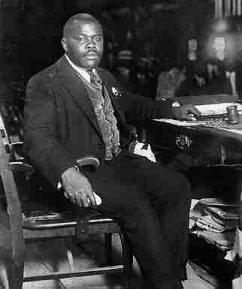
The Honorable Marcus Garvey Founder of the Universal Negro Improvement Association (UNIA)


However, it wasn't until I was in college that I truly began to have a deep appreciation for Garvey.  After having participated in civil rights activities as a child in Oklahoma since the age of 10, and having the push back by rednecks who didn't want us to eat, shop, entertain, or be educated with them, by the time I was 18, I had had enough and had decided that I was no longer participating in marches to integrate with whites.  It was then that I totally understood why he was trying to get us to move back to Africa and be in our own country, with our own people, our own government, and our own wealth and economy. 

As a student at Lincoln University (Black in the day), all seniors were required to submit a senior thesis and defend it in order to graduate. Mine happened to have been about W.E.B. DuBois and Marcus Garvey. I read their philosophies, biographies, writings, and news articles about them.  It was such a wonderful revelation because of so many things I learned through Garvey's own voice.
 
To my dismay, however,  I learned that W.E.B. DuBois was against Marcus Garvey, and was used as a tool by whites to try to paint Garvey as a charlatan. They even had front page articles in white news papers with DuBois putting Garvey's concepts and ideas down. This is deeply disturbing because of all the wonderful things he had written that I was required to read in High School in OKC. The irony of the whole thing was that Garvey was sabotaged by his white detractors who were hell bent on keeping Africans and African Americans form reuniting. He was falsely accused of mail fraud because Black people sent him money in the mail to purchase the ships that would transport them back to Africa. He purchased the ships - however, due to sabotage, they were unseaworthy. The rest is travesty and white hidstory. 
 
Ironically still, DuBois ended up expatriating to Africa - Ghana to be exact - when he began to be persecuted by the same whites who played on his ego and got him to denounce Garvey in the first place. He ended up apologizing for having been involved in the destruction of the BACK TO AFRICA MOVEMENT. Too little too late - and here we are - the descendants of 12 million Black Americans who were all ready to go home and reunite with their families - undermined by whites who had vested interests in the rape of Africa, and who wanted to retain us as their cheap labor force.
 
TODAY, AUGUST 17, 2020 IS MARCUS GARVEY'S 133rd BIRTHDAY ANNIVERSARY. 
 
My Grandmom was a Garveyite, as were many Oklahomans - there were many who were ready to pull up stakes, get out of this racist redneck environment and regroup in a country where their origins lie. There were many who were not. The bottom line is that we might have become the Wakanda depicted in the movie BLACK PANTHER, had we not been undermined. 
 
So,  we are still here!!   And how many can say that we have it any better  today than we did when Garvey first came here and tried to wake Black people up Black then? 
 
As you celebrate GARVEY'S BIRTHDAY ANNIVERSARY PLEASE MEDITATE ON WHAT WE WHO APPEAR TO BE STUCK HERE CAN DO TO MAKE OUR LIVES BETTER TOGETHER; AND HOW WE CAN ALSO JOIN WITH OUR BROTHERS AND SISTERS IN THE MOTHERLAND IN MAKING THEIR LIVES BETTER AS WELL. 
BLACK LIVES MATTER - 
AFRICA FOR THE AFRICANS, AT HOME AND ABROAD; 
WE ARE FAMILY! 
UP YOU MIGHTY RACE, YOU CAN ACCOMPLISH WHAT YOU WILL!!
 
There have been several pieces written about Garvey - much of them really don't do this wonderful brother justice. There is a filmstrip from History.com that is pure hogwash!! 
 
If you don't take the time to do your own homework, you will get the distorted version of this wonderful charismatic, genius who galvanized 12 MILLION BLACK PEOPLE without Instagram, FaceBook, TV - just his intelligence, love, fervor, and the courage to stand for what he believed. 
 
The link below is the closest i've come to contemporary information about all Marcus Garvey - the JAMAICAN BROTHER WHO WOKE AFRICAN AMERICANS UP!


http://nationalhumanitiescenter.org/tserve/twenty/tkeyinfo/garvey.htm


Marcus Garvey and the Universal Negro Improvement Association
David Van Leeuwen ©National Humanities Center
Links to online resources
Related info in
  "Getting Back to You"
Works cited


Marcus Garvey presiding at 1922 UNIA convention
Marcus Garvey presiding at the 1922 UNIA convention,
Liberty Hall, New York City
Courtesy The Marcus Garvey and UNIA Papers Project, UCLA
Marcus Garvey and his organization, the Universal Negro Improvement Association (UNIA), represent the largest mass movement in African-American history. Proclaiming a black nationalist "Back to Africa" message, Garvey and the UNIA established 700 branches in thirty-eight states by the early 1920s. While chapters existed in the larger urban areas such as New York, Chicago, and Los Angeles, Garvey's message reached into small towns across the country as well. Later groups such as Father Divine's Universal Peace Mission Movement and the Nation of Islam drew members and philosophy from Garvey's organization, and the UNIA's appeal and influence were felt not only in America but in Canada, the Caribbean, and throughout Africa.
Garvey's philosophy and organization had a rich religious component that he blended with the political and economic aspects.
Considering the strong political and economic black nationalism of Garvey's movement, it may seem odd to include an essay on him in a Web site on religion in America. However, his philosophy and organization had a rich religious component that he blended with the political and economic aspects. Garvey himself claimed that his "Declaration of Rights of the Negro Peoples of the World," along with the Bible, served as "the Holy Writ for our Negro Race." He stated very clearly that "as we pray to Almighty God to save us through his Holy Words so shall we with confidence in ourselves follow the sentiment of the Declaration of Rights and carve our way to liberty." For Garvey, it was no less than the will of God for black people to be free to determine their own destiny. His organization took as its motto "One God! One Aim! One Destiny!" and looked to the literal fulfillment of Psalm 68:31: "Princes shall come out of Egypt: Ethiopia shall soon stretch forth her hands unto God." 

Garvey was born in 1887 in St. Anne's Bay, Jamaica. Due to the economic hardship of his family, he left school at age fourteen and learned the printing and newspaper business. He became interested in politics and soon got involved in projects aimed at helping those on the bottom of society. Unsatisfied with his work, he travelled to London in 1912 and stayed in England for two years. During this time he paid close attention to the controversy between Ireland and England concerning Ireland's independence. He was also exposed to the ideas and writings of a group of black colonial writers that came together in London around the African Times and Orient Review. Nationalism in both Ireland and Africa along with ideas such as race conservation undoubtedly had an impact on Garvey.

However, he later remembered that the most influential experience of his stay in London was reading Booker T. Washington's autobiography Up From Slavery. Washington believed African Americans needed to improve themselves first, showing whites in America that they deserved equal rights. Although politically involved behind the scenes, Washington repeatedly claimed that African Americans would not benefit from political activism and started an industrial training school in Alabama that embodied his own philosophy of self-help. Garvey embraced Washington's ideas and returned to Jamaica in 1914 to found the UNIA with the motto "One God! One Aim! One Destiny!"

Initially he kept very much in line with Washington by encouraging his fellow Jamaicans of African descent to work hard, demonstrate good morals and a strong character, and not worry about politics as a tool to advance their cause. Garvey did not make much headway in Jamaica and decided to visit America in order to meet Booker T. Washington and learn more about the situation of African Americans. By the time Garvey arrived in America in 1916, Washington had died, but Garvey decided to travel around the country and observe African Americans and their struggle for equal rights.

What Garvey saw was a shifting population and a diminishing hope in Jim Crow's demise. African Americans were moving in large numbers out of the rural South and into the urban areas of both North and South. As World War One came to an end, disillusionment was beginning to take hold. Not only was the optimism in the continuing improvement of humanity and society broken apart, but so was any hope on the part of African Americans that they would gain the rights enjoyed by every white American citizen. African Americans had served in large numbers in the war, and many expected some kind of respect and acknowledgment that they too were equal citizens. Indeed, World War One was the perfect opportunity for African Americans to fulfill Booker T. Washington's requirement for equality and freedom. Through dedicated service in the armed forces, they could prove their worth and show they deserved the same rights as whites. However, as black soldiers returned from the war, and more and more African Americans moved into the urban areas, racial tensions grew. Between 1917 and 1919 race riots erupted in East St. Louis, Chicago, Tulsa, and other cities, demonstrating that whites did not intend to treat African Americans any differently than they had before the war.

After surveying the racial situation in America, Garvey was convinced that integration would never happen and that only economic, political, and cultural success on the part of African Americans would bring about equality and respect. With this goal he established the headquarters of the UNIA in New York in 1917 and began to spread a message of black nationalism and the eventual return to Africa of all people of African descent. His brand of black nationalism had three components—unity, pride in the African cultural heritage, and complete autonomy. Garvey believed people of African descent could establish a great independent nation in their ancient homeland of Africa. He took the self-help message of Washington and adapted it to the situation he saw in America, taking a somewhat individualistic, integrationist philosophy and turning it into a more corporate, politically-minded, nation-building message.

In 1919 Garvey purchased an auditorium in Harlem and named it Liberty Hall. There he held nightly meetings to get his message out, sometimes to an audience of six thousand. In 1918 he began a newspaper, Negro World, which by 1920 had a circulation somewhere between 50,000 and 200,000. Membership in the UNIA is difficult to assess. At one point, Garvey claimed to have six million members. That figure is most likely inflated. However, it is beyond dispute that millions were involved and directly affected by Garvey and his message.

To promote unity, Garvey encouraged African Americans to be concerned with themselves first. He stated after World War One that "[t]he first dying that is to be done by the black man in the future will be done to make himself free. And then when we are finished, if we have any charity to bestow, we may die for the white man. But as for me, I think I have stopped dying for him." Black people had to do the work that success and independence demanded, and, most important, they had to do that work for themselves. "If you want liberty," claimed Garvey to a meeting held in 1921, "you yourselves must strike the blow. If you must be free, you must become so through your own effort."

But Garvey knew African Americans would not take action if they did not change their perceptions of themselves. He hammered home the idea of racial pride by celebrating the African past and encouraging African Americans to be proud of their heritage and proud of the way they looked. Garvey proclaimed "black is beautiful" long before it became popular in the 1960s. He wanted African Americans to see themselves as members of a mighty race. "We must canonize our own saints, create our own martyrs, and elevate to positions of fame and honor black men and women who have made their distinct contributions to our racial history." He encouraged parents to give their children "dolls that look like them to play with and cuddle," and he did not want black people thinking of themselves in a defeatist way. "I am the equal of any white man; I want you to feel the same way."

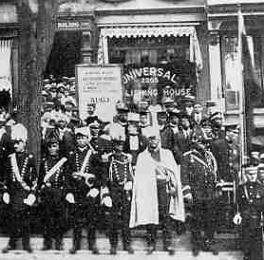
Garvey organized his group in a way that made those sentiments visible. He created an African Legion that dressed in military garb, uniformed marching bands, and other auxiliary groups such as the Black Cross Nurses.
Marcus Garvey with UNIA leaders, 1922 UNIA convention
Marcus Garvey with Potentate Gabriel M. Johnson of Liberia, Supreme Deputy G.O. Marke of Sierra Leone, and other UNIA leaders review the parade opening the 1922 UNIA convention,
New York City
Courtesy The Marcus Garvey and UNIA Papers Project, UCLA
He was elected in 1920 as provisional President of Africa by the members of the UNIA and dressed in a military uniform with a plumed hat. At the UNIA's First International Convention in 1920, people lined the streets of Harlem to watch Garvey and his followers, dressed in their military outfits, march to their meeting under banners that read "We Want a Black Civilization" and "Africa Must Be Free." All the pomp brought Garvey ridicule from mainstream African-American leaders, but it also served to inspire many African Americans who had never seen black people so bold and daring.

While racial pride and unity played important roles in Garvey's black nationalism, he touted capitalism as the tool that would establish African Americans as an independent group. His message has been called the evangel of black success, for he believed economic success was the quickest and most effective way to independence. Interestingly enough, it was white America that served as a prime example of what blacks could accomplish. "Until you produce what the white man has produced," he claimed, "you will not be his equal." In 1919 he established the Negro Factories Corporation and offered stock for African Americans to buy. He wanted to produce everything that a nation needed so that African Americans could completely rely on their own efforts. At one point the corporation operated three grocery stores, two restaurants, a printing plant, a steam laundry, and owned several buildings and trucks in New York City alone. His most famous economic venture was a shipping company known as the Black Star Line, a counterpart to a white-owned company called the White Star Line. Garvey started the shipping company in 1919 as a way to promote trade but also to transport passengers to Africa. He believed it could also serve as an important and tangible sign of black success. However the shipping company eventually failed due to expensive repairs, mismanagement, and corruption.

With all his talk of a mighty race that would one day rule Africa, it would have been foolish for Garvey to underestimate the power of religion, particularly Christianity, within the African-American community. The churches served as the only arena in which African Americans exercised full control. Not only did they serve as houses of worship but also as meeting places that dealt with social, economic, and political issues. Pastors were the most powerful people in the community for they influenced and controlled the community's most important institution. Garvey knew the important place religion held, and he worked hard to recruit pastors into his organization. He enjoyed tremendous success at winning over leaders from almost every denomination. One of those clergymen, George Alexander McGuire, an Episcopalian, was elected chaplain-general of the UNIA in 1920. McGuire wrote the UNIA's official liturgy, the "Universal Negro Ritual" and the "Universal Negro Catechism" that set forth the teachings of the UNIA. He attempted to shape the UNIA into a Christian black-nationalist organization. Garvey, however, did not want the organization to take on the trappings of one particular denomination, for he did not want to offend any of its members. McGuire left UNIA in 1921 to begin his own church, the African Orthodox Church, a black-nationalist neo-Anglican denomination that kept close ties with the UNIA.

The UNIA meetings at Liberty Hall in Harlem were rich with religious ritual and language, as Randall Burkett points out in his book Black Redemption: Churchmen Speak for the Garvey Movement. For even though Garvey rejected McGuire's effort to transform the UNIA into a black-nationalist Christian denomination, he blended these two traditions in his message and in the form of his UNIA meetings. A typical meeting followed this order:
  • The hymn "Shine On, Eternal Light," written specifically for the UNIA by its music director
  • A reading of Psalm 68:31: "Princes shall come out of Egypt: Ethiopia shall soon stretch forth her hands unto God."
  • The official opening hymn "From Greenland's Icy Mountains," stating a commitment to the Christianization of Africa
  • Recitation of the official motto, "One God! One Aim! One Destiny!"
  • "The Lord's Prayer" and other prayers spoken by the chaplain
  • A sermon or some brief remarks
  • The business meeting
  • The closing hymn, either "Onward Christian Soldiers" or the UNIA's national anthem, the "Universal Negro Anthem."
Garvey's black nationalism blended with his Christian outlook rather dramatically when he claimed that African Americans should view God "through our own spectacles." If whites could view God as white, then blacks could view God as black. In 1924 the convention canonized Jesus Christ as a "Black Man of Sorrows" and the Virgin Mary as a "Black Madonna." Garvey used that image as an inspiration to succeed in this life, for African Americans needed to worship a God that understood their plight, understood their suffering, and would help them overcome their present state. Garvey was not interested in promoting hope in the afterlife. Success in this life was the key. Achieving economic, cultural, social, and political success would free African Americans in this life. The afterlife would take care of itself. Perhaps Garvey's greatest genius was taking that message of material, social, and political success and transforming it into a religious message, one that could lead to "conversion," one that did not challenge the basic doctrines of his followers but incorporated them into the whole of his vision. One of Garvey's top ministers gave witness to the powerful effect of that message when he claimed in 1920, "I feel that I am a full-fledged minister of the African gospel."

Garvey's message of black nationalism and a free black Africa met considerable resistance from other African-American leaders. W.E.B. DuBois and James Weldon Johnson of the NAACP, and Chandler Owen and A. Philip Randolph of the publication Messenger, had their doubts about Garvey. By 1922 his rhetoric shifted away from a confrontational stance against white America to a position of separatism mixed with just enough cooperation. He applauded whites who promoted the idea of sending African Americans back to Africa. He even met with a prominent leader of the Ku Klux Klan in Atlanta in 1922 to discuss their views on miscegenation and social equality. That meeting only gave more fuel to his critics. In 1924 DuBois claimed that "Marcus Garvey is the most dangerous enemy of the Negro race in America and in the world." Owen and Randolph, whose paper saw the race issue as one of class more than skin color, called Garvey the "messenger boy of the Klan" and a "Supreme Negro Jamaican jackass" while labeling his organization the "Uninformed Negroes Infamous Association." The federal government also took an interest in Garvey and in 1922 indicted him for mail fraud. He was eventually sentenced to prison and began serving his sentence in 1925. When his sentence was commuted two years later, Garvey was deported to Jamaica. With his imprisonment and deportation, his organization in the United States lost much of its momentum. Garvey spent the last years of his life in London and died in 1940.

Guiding Student Discussion

In my experience with undergraduates, I find that students know little if anything about Marcus Garvey. The simplest way to get their attention is to tell them that Garvey's UNIA was bigger than the Civil Rights Movement, which most of them do know something about. Telling them that Garvey's influence extended well beyond the borders of the United States to the Caribbean, Canada, and Africa may also pique their interest. Pointing out that Garvey's message had a tremendous influence on later groups such as the Rastafarians and the Nation of Islam is also important. Much of what he said concerning racial pride and the potential for great racial success can be heard in later figures such as Malcolm X and even Stokely Carmichael, leader of SNCC (Student Non-Violent Coordinating Committee). Garvey, Malcolm, and Carmichael are all considered more radical than the mainstream civil rights protesters, yet it was Booker T. Washington, someone considered quite conservative by most scholars, who had a profound influence on Garvey. Exploring that connection between the accommodationist philosophy of Washington and the black nationalism of Garvey and the other leaders might generate the most interest and help the students see the important place that Garvey holds in American history.

You might also bring up Garvey's insistence that African Americans should see God, Jesus, and Mary as black. What is Garvey trying to do here? Why not throw out the religion of Christianity, which was used as a rationale for keeping slaves and viewing blacks as inferior people, and form a new religion that could communicate the hopes and desires of people of African descent? Why not do as the later group, the Nation of Islam, and remove all white influence? You might talk about Christianity itself, how blacks identified with so many of the stories of the Bible, the people of Israel, the suffering of Jesus, and how African American's understanding of Christianity in many ways may already have been "black." You might also talk about the role religion plays in a group such as Garvey's. Why is religion so important here; why does it play any role at all? Why couldn't Garvey simply preach black nationalism in economic, political, and social terms? What does religious expression do for people in an organization like the UNIA?

Historians Debate

Scholars have debated the influence and relevance of Garvey, with assessments ranging from Garvey as little more than a demagogue whose uniqueness points to his irrelevance, to Garvey and his organization as earlier embodiments of the political battles of the 1960s. This debate is partly due to the fact that, until quite recently, sources for any study of the Garvey movement were difficult to obtain. Many were destroyed when the government deported Garvey, and some were lost in the air raids in London where Garvey spent the last years of his life.

E. David Cronon's Black Moses: The Story of Marcus Garvey and the Universal Negro Improvement Association (1969) is an example of a more negative assessment of Garvey. Tony Martin's Marcus Garvey, Hero: A First Biography (1983) and Race First: The Ideological and Organizational Struggle of Marcus Garvey and the Universal Negro Improvement Association (1976), along with Theodore Vincent's Black Power and the Garvey Movement (1971) are much more positive about Garvey and his influence. Vincent provides some valuable information about later groups that were influenced by Garvey. For example, Elijah Poole, later known as Elijah Muhammed, was a Garveyite in Chicago and later became leader of the Nation of Islam. Judith Stein in The World of Marcus Garvey: Race and Class in Modern Society (1986) attempts to occupy some middle ground in the debate, not seeing Garvey and the UNIA as a precursor to the politics of the 1960s but also not dismissing Garvey as irrelevant. 

An article that present a good summary of Garvey and his movement is Lawrence Levin's "Marcus Garvey and the Politics of Revitalization" in Black Leaders of the Twentieth Century, edited by John Hope Franklin and August Meier (1982). For the religious aspects of the Garvey movement in the United States, look to Randall K. Burkett's Black Redemption: Churchmen Speak for the Garvey Movement (1978) and Garveyism as a Religious Movement: The Institutionalization of a Black Civil Religion (1978).

The most important contribution to studies on Garvey is Robert A. Hill's The Marcus Garvey and Universal Negro Improvement Association Papers (1983). Hill essentially brought the Garvey archive together by traveling the world and collecting every piece of paper he could find that had something to do with Garvey. He covers the UNIA's activity in the United States, the Caribbean, and Africa. He explores the influence of Ireland and its struggle for independence on Garvey's thinking and suggests that New Thought may have had some influence on Garvey as well. His general introduction and his more specific introduction, which are available online (see links) are outstanding and provide a concise summary of Garvey and the UNIA.

Just so you'll know, I deliberately reprinted the entire article on Garvey - it's well written but still much too abbreviated to give a true sense of what he really stands for.  

If you read this much, you'll be much farther ahead than most.  I urge you to get hold of his book and really study this wonderful, charismatic genius and Black activist.   

It's amazing to me still how he was able to galvanize millions of Black people when in today's world we're hard pressed to get 3 Black people to stick together.  It appears to me that we need to stop being so smug about our contemporary world and give credit to this great Black man.  More importantly, we would do well to study and inculcate his philosophies and methodologies.  We might just begin to develop the unity and autonomy we need to move our people forward.

Again HAPPY BIRTHDAY TO MARCUS GARVEY - THANKS SO MUCH FOR ALL YOU DID FOR BLACK PEOPLE.

NOW THAT YOU KNOW
WHAT ARE YOU GOING TO DO ABOUT IT?

Stay Blessed & 
ECLECTICALLY BLACK 


-->

6.05.2020

WE CANNOT REMAIN SILENT! Africans in Africa and Around the World in Solidarity With African American Sisters and Brothers


By Gloria Dulan-Wilson

Hello All:


Our brothers and sisters in Africa have sent us a note of  that I am sharing with you.   It was forwarded to me by the Hon. Stanley Straughter of the Mayor's Commission on African and Caribbean Immigrant Affairs of Philadelphia, PA.  They have observed the heinous treatment of Brother George Floyd and are reaching out across the Diaspora to let us know that we are not along.  We are grateful to the outpouring of love, indignation, solidarity from our Brothers and Sisters in the Mother Land:


WE CANNOT REMAIN SILENT! 
Africans in Africa and Around the World in Solidarity With African-American Sisters And Brothers. 
DAKAR In these strange moments of uncertainty and fear, the news from America has broken our hearts. We cannot remain silent! We cannot remain deaf and blind to the plight of our African-American brothers and sisters. We are shocked by the brutal murder of George Floyd by police officers. The unbearable sight of George Floyd suffocating under the knee of a police officer in uniform looks like a return to the dark ages. George Floyd’s agony and death crowns a long litany of screams and supplications, adding one more atrocity to a chain of brutalities and racist killings. — It has revived in us the old wounds of our souls and summoned painful, shared memories. 
We cannot remain silent because we know how much we have in common with our brothers and sisters in our global black community - our African Diaspora. We know how your ancestors continued the resistance and the struggle for emancipation and dignity during the solitary traumas lived in the hulls of slave boats and the humiliation of plantations, and on the islands of freedom they built through the ages. That is the determined struggle for civil rights that you continue to wage fearlessly. Africans on the continent and around the world are grateful to African Americans and black leaders, writers, and thinkers for sharing with our elders the emancipatory idea of Pan-Africanism and for being connected with our struggles against colonialism and, of course, apartheid. 
No, we cannot remain silent with the cruel killing of George Floyd and the cries of citizens, black and brown and white, in the streets of cities in America and in other continents, declaring to the world that Black Lives Matter. 
How can we be silent when we know that your long walk to real freedom echoes the struggles of yesterday and resonates with the struggles we are waging here in Africa, your mother continent? We are waging these struggles to advance our common causes: democratic freedoms, dignity, equality, social justice, the rights and well-being of women and all minorities, the integrity of leaders and institutions, economic independence, and finally the control of our cultural and historic destiny.
We cannot remain unmoved when we also have good news to share with our African American brothers and sisters; news that goes beyond the clichés, rebukes all forms of racial profiling, and updates old beliefs into fresh reality: a new Africa is truly emerging before our eyes. A resilient Africa carried by our communities and a dynamic and enterprising civil society, animated by a generation of young people and women determined to lift the continent from the fatality of despair, and create a future of unity in freedom, dignity and abundance. Together, we are the soldiers of hope engaged in the building of a new African nation, deeply rooted in our strongest cultural heritage, with the ideological and intellectual contributions of African-American achievements. In this spirit, we the people of Africa are one people, and one nation. We are a 1.3 billion strong nation stretched out over a whole continent, and with you in the African Diaspora, we are millions more. Together we can build the global African nation. It will be our nation, and we will name squares and schools after the countless other heroines and heroes of African descent. In memory of our common ancestry, the new Africa will be conceived as our common home. 
We cannot remain silent! We cannot remain indifferent because we have so many projects to initiate. One common element of our societal (and economic) project will be to revisit together — with courage and honesty — our shared history. But we will go beyond the recent history and look at the Africa we lost. Our history did not begin with the tragic period of slavery. We will explore the distant lands of our forgotten kingdoms and empires, the glorious destinies of our noble leaders, the scientific, technological and social advances that have shaped the evolution of our societies and have largely gone unacknowledged. Our common work should be to finally put at the center of our concerns the education and training of our children so that they are better prepared to face the complex challenges of what will certainly be a complex future. 
Finally Our common task could be to develop mutually beneficial economic partnerships among those of us on the continent and those in the Diaspora, in order to create the conditions for true independence. And while we break our silence, we will claim our rightful place in human destiny. In these decisive moments when humanity is confronted with an existential threat linked to climate change, health pandemics, and a life-threatening rise of social inequalities, we must come together. 
We have never forgotten that humanity originated on our continent. At this critical and fragile moment when humankind feels that it has reached a tragic impasse, it is our duty to help humanity build a better and more sustainable future for itself and for planet Earth, through the path of our founding values —'ubuntu’ and ‘nitté’ (our shared humanity), wisdom, equality, respect, solidarity, and brotherhood and sisterhood, so that our human family finally reconciles with itself in peace. 
Today, in the memory of George Floyd and millions of other black lives who mattered, we Africans in Africa, mourn our loss and honor a rich moment of shared connection. 
Add your name by following this link: http://chng.it/XgF7rL4z 

SIGNED BY:

Youssou Ndour
Akon
Salif Keita
Dikembe Mutombo
Samuel Etoo
Djimon Honsou
Ameenah Gurib-Fakim
Lamido Sanusi
Princess Esther Kamatari
Precious Motsepe
Rama Yade
Paolo Gomes
Prof. Abdoulaye Bathily
Zainab Badawi
Isha Seesay
Amadou Mahtar Ba
Alain Foka
Denise Epote Durand
Frannie Leautier
Bineta Diop
Hafsat Abiola
Hassan Ba
Pierre Thiam
Angelle Kwemo
Amadou Gallo Fall
Dr. Ebrima Sall
Prof. Achille Mbembe
Dr. Fatou Sow
Prof. Muhammadou Kah
Prof Issa Shivji
Prof. Alioune Sall
Prof. Penda Mbow
Dr. Natasha Issa Shivji
Dr. Bouchra Sidi Hida
Dr. Salwa Beheiry
Prof. Jimi O. Adesina
Momar Nguer
Alain Nkontchou
Fatima Karume
Prof. Mamadou Goita
Prof. Brahim El Morchid
Dr. Tijan M. Sallah
Fatou Jagne Senghor
Dr.Stigmata Tenga
Dr. Ebrima Ceesay
Prof. Abdoulie Saine
Samba Bathily
Mamadou Toure
Prof. Ousmane Thiare
Prof. Jainaba M. L. Kah
Dr. Assan Jaye
Linus Gitahi
Demba Sy
Debo Adesina
Rebecca Enonchong
Moustapha Mellouk
Prof. Bernard Founou Tcuigoua
Dr. Tendai Kedenhe Mhizha


Prof. Noel Magaloire Ndoba
Coumba Toure
Babacar Ngom
Amadou Diaw
Didier Acouetey
Harouna Ly
Mamou Daffe
Hamet Aguemon
Seynobou Dia
Masego Madzwamuse
Sefa Gohoho
Obi Asika
Edgar Gnansounou
John Githongo


-->

GOD BLESS BLACK PEOPLE/GDW