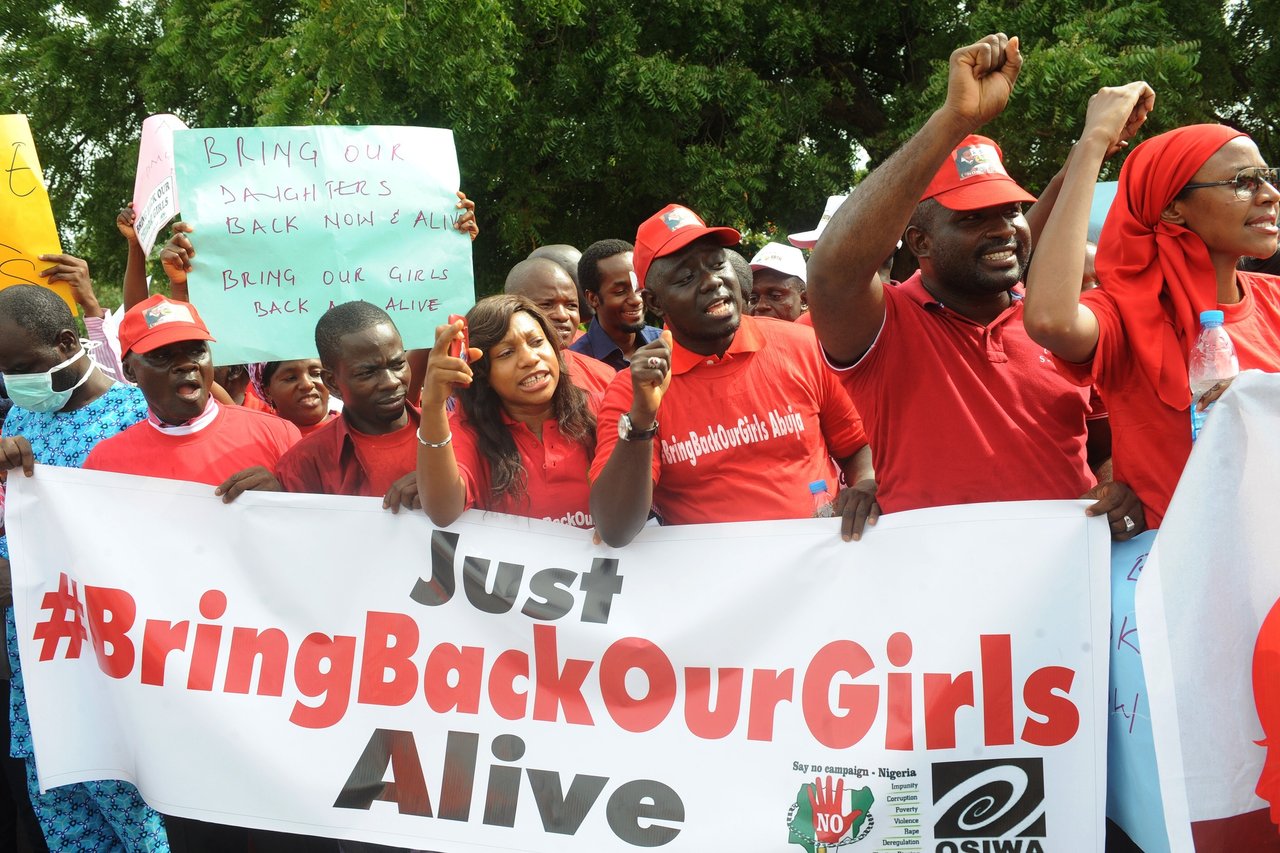
"Hashtag activism" is one of the most delectable slurs in our
modern lexicon. It's a perfect encapsulation of the delusional
narcissism and utter pettiness of people who think sharing a photo is
the ultimate political act; that enough 140-character missives can put an end to a long-running civil war.
Improbably, #BringBackOurGirls has been a qualified success
So in theory, the #BringBackOurGirls campaign, aimed at rescuing the
Nigerian girls abducted by the Islamist group Boko Haram, should be
terrible. It's a social media campaign hijacked by a bunch of Westerners
who probably couldn't find Nigeria on a map attempting to solve a
problem, a violent Islamist insurgency, they only dimly understand.
Yet, improbably, #BringBackOurGirls has been a qualified success. The
girls aren't back, but the hashtag campaign has done about as much as
anyone could have realistically expected: helped Nigerians make their
government, whose inaction is a huge part of the problem, listen to
their demands.
Some recent history is useful here. Everyone and their mothers is comparing #BringBackOurGirls to that
other well-known hashtag campaign about an African militant group,
#Kony2012. That past campaign aimed to pressure the US government to
"get" Joseph Kony, the leader of the vicious Lord's Resistance Army
operating in and around northern Uganda.
There are lots of various similarities and differences between
#Kony2012 — Daniel Solomon has put together a brilliant, comprehensive
rundown
here.
The most salient one Dan lists, to my mind, is their stark difference
in goals. #Kony2012 was a campaign by Western activists to push their
pet solution to the Lord's Resistance Army problem; #BringBackOurGirls
was originally a push by local Nigerian activists to get their own
government to pay even the slightest attention to the kidnapped girls.
One campaign saw a simple military problem; the other a complex
situation where an incompetent government is (arguably) one of the root
causes of the instability that allows militant violence to sustain
itself.
#Kony2012 told a simple story because their simplistic, arguably harmful solution required a simple, wrong diagnosis
These differences have shaped everything that followed about the two
campaigns. #Kony2012 peddled, as Uganda watcher Mark Kersten
puts it,
an "obfuscating, simplified and wildly erroneous narrative of a
legitimate, terror-fighting, innocent partner of the West (the
Government of Uganda) seeking to eliminate a band of lunatic,
child-thieving, machine-gun wielding mystics (the LRA)."
#Kony2012 told a simple story because their simplistic, arguably
harmful solution required a simple, wrong diagnosis. Likewise with the
#Kony2012 promotional material centering on the story of a white,
American child (who happened to be the son of one of the campaign's
founders). White Americans needed to be the central actors in Uganda's
drama because that's the role #Kony2012's creators seemed to believed
they should play.
#BringBackOurGirls is, as the New York Times' Lydia Polgren
put it,
"the opposite of #Kony2012." When #BringBackOurGirls began, Nigerian
President Goodluck Jonathan had yet to say a thing about the abduction
of hundreds of girls. Nigerians like
Oby Ezekwesili and
Ibrahim Abdullahi
felt like they used the hashtag as a means of coordinating and
enhancing the local campaign to pressure the Jonathan government. The
Nigerian hashtag activism worked to enhance real, democratic activism by
Nigerians — far and away the most important reason to think that social
media helped here.
The hashtag activism worked to enhance real activism
This local-ness also totally transformed the valence of the
international hashtag campaign that came after. Western tweeters were
serving as a support brigade to local Nigerian activists, whether they
meant to or not, bringing international as well as domestic pressure to
bear on the Jonathan government's indifference. It's not a
Western-imposed solution; it's Western backup for local activists whose
weapon is public protest and dissent. The internet serves as an
extension of the
large Nigerian protests.
This, as a number of scholars of international relations will tell
you, is a tried-and-true strategy for putting pressure on local
governments. "Moral consciousness-raising by the international human
rights community often involves a process of 'shaming,'" professors
Kathryn Sikkink and Thomas Risse
write.
Shaming "implies a process of persuasion, since it convinces leaders
that their behavior is inconsistent with an identity to which they
aspire."
We can't know for sure how much the specter of international
embarrassment complimented the much more important local pressure
campaign on Jonathan, but if it did provide an assist, then it's much
more productive than #Kony2012 ever was.
Now, #BringBackOurGirls actually helped
bring about
an American deployment in Nigeria. So if you opposed #Kony2012 on
grounds that Western involvement is necessarily bad, that'd be a strike
against #BringBackBackOurGirls. However, the structure of the campaign
transformed again the outcome. The US deployment to Nigeria isn't a
massive ground troop intervention or series of drone strikes. In fact,
it's
entirely non-combat:
law enforcement, hostage negotiation, and military experts are
assisting the Nigerian government's search campaign. In other words, the
international support could help keep Jonathan honest, helping ensure
that he's actually devoting resources to the search for the missing
girls. Once again, the international efforts compliment the Nigerian
demands for their government to take action.
Nigerians were already pretty well aware of the violent group bombing targets around their country before Americans got involved
Not that the campaign is totally unproblematic. Western involvement
could spiral out of control, or prompt a violent, inhumane crackdown by
the Nigerian government itself (it has a pretty awful human rights
record in anti-Boko Haram operations). More directly, it could
perversely
help Boko Haram. Political scientist Will Moore, noting that terrorist groups can only sow terror if
people pay attention to their attacks, worries that all this attention could actually increase Boko Haram's power to intimidate Nigerians. It's
a real concern, though I'd note that Nigerians were already pretty well
aware of the violent group bombing targets around their country before
Americans got involved.
Perhaps most fundamentally, we're still only a few weeks into the
sustained international campaign surrounding the Chibok girls. The US
Senate hasn't yet held planned hearings on the topic, so there's still
plenty of ways the international campaign can go sour. And the local
campaign still hasn't succeeded in bringing the girls back.
Nevertheless, what we've seen so far is encouraging. International
activists have supported a truly local, democratic demand for
accountability from the Nigerian people to the Nigerian government — who
themselves were directing and shaping the social media campaign's
direction. Not bad for some hashtag activists.
That's under dispute.
The government claims to be working hard to find the girls, but the
family of the girls and local activists don't really believe them.
Meanwhile, Boko Haram has kidnapped at least
8 more girls in Borno.
President Goodluck Jonathan didn't speak about the Chibok abduction for roughly three weeks after it happened. When he did, on
May 5th, he
denied that negotiations were ongoing, but promised to get the girls back. He has set up a
committee
to plan a strategy for rescuing the girls, and believes, according the
AP, that current military efforts will find them. On May 7, the Nigerian
police
offered a $312,000 reward for any useful information about the girls.
It's not actually clear what the government's military efforts are, and Nigerians
have been protesting
to put pressure on Jonathan to do more. "We have a national leader who
is supposed to champion the protection of the entire country," said
Aishatu Ngulde, a member of Baobab for Women's Human Rights,
told
Voice of America. "But since this thing happened, we have never had our
president tell the entire nation that he is deploying our air force
with their jets." Protests are still ongoing; you can follow pictures of them on Nigerian writer and lawyer Elnathan John's
Twitter feed.
It
should be said that the Jonathan government doesn't have a great record on human
rights and civilian protection. In 2013, the president declared a state
of emergency in Borno, Yobe, and Adawama states and cracked down on
Boko Haram activities. It didn't stamp out the group, and, according to
Human Rights Watch, the security forces "engaged in the indiscriminate
arrest, detention, torture, and extra-judicial killing of those
suspected to be supporters or members of the Islamist group."