Showing posts with label Liberia. Show all posts

5.23.2022

GDW EVENT ALERT: ACANA PRESENTS: Bridging The Gap: 200 Years of US - Liberia Ties - Wednesday May 25, 2022

By Gloria DULAN-Wilson
Hello All:

This Wednesday, May 25, is World African Heritage Day - which was established in 1963 during the beginning of the liberation of African countries from colonization and oppression.  This year marks the 59th Anniversary celebration.  What better way to commemorate and celebrate it than a tribute to Liberia which is celebrating its 200th Anniversary year! And what better place to celebrate both events than Lincoln University's Graduate Center.  Lincoln University, the world's first HBCU, established as a degree granting university in 1854 - six  years before the outbreak of the Civil War, was established to provide missionaries and educators to Liberia, West Africa.  The ties between Lincoln and Liberia have remained cordial ever since.  I remember several of my friends from Liberia who were at Lincoln to get their degrees and return to their home to take what they learned back to further enhance their country.  While still others of my classmates remained in the US and distinguished themselves in their chosen fields of interests.  This is one in the many events that will be featured on a monthly basis leading up to the gala celebration in November of Liberia's bi-centennial.

Bridging The Gap: 200 Years of U.S.- Liberia Ties


Bridging The Gap: 

200 Years of US - Liberia Ties

Date and time

Wed, May 25, 2022

5:30 PM – 7:30 PM EDT


Bridging The Gap: 200 Years of U.S.- Liberia Ties

Lincoln University Graduate Center

3020 Market Street, Philadelphia, PA 19104


Free / Share with friends

Event Information


Commemorating 200 Years of the arrival of Free Black Americans on the shores of West Africa, resulting in the establishment of Liberia.

About this event

The Philadelphia-Liberia Bicentennial is the celebration of the arrival of Free Black Americans on the shores of West Africa, resulting in the establishment of the Republic of Liberia, West Africa.

On May 25th, the City of Philadelphia Mayor's Commission on African and Caribbean Immigrant Affairs, African Cultural Alliance of North America (ACANA), Liberian Ministerial Alliance in North America, Liberian Chamber of Commerce, and African and Caribbean Business Council of Greater Philadelphia, will jointly host a panel discussion under the theme: Bridging the Gaps Between U.S., Philadelphia, and Liberia. The panelist will consist of scholars from Lincoln University, Cheyney University, and Temple University


NOW THAT YOU KNOW

WHAT ARE YOU GOING TO DO ABOUT IT?


Stay Blessed &

ECLECTICALLY BLACK 


Use ⌘ + scroll to zoom the maTags


2.12.2020

Happy 211th Birthday Abraham Lincoln

By Gloria Dulan-Wilson

Hello All:

HAPPY BLACK HISTORY MONTH!!!!


When Carter G. Woodson started Negro History Week, now known as Black History Month, he set the date for the second week in February to commemorate two men he admired the most - Frederick Douglas, born February 14, 1818, and Abraham Lincoln was born February 12, 1809 - to honor them for their contribution to Black people during their lifetime, when it was clearly perilous to have done so.  In fact, in Lincoln's case, it turned out to be fatal, because he was assassinated by a racist white actor who was part of a group who tried to terrorize Black people into returning to the plantations - John Wilkes Booth.  

Carter G.Woodson who started Negro History Week in the early 1920s


Many of our Black comedians, unaware of the historical significance, joke that white people gave us the shortest month the year for celebrating our history, without realizing that it an act of self empowerment because Dr. Carter Godwin Woodson was determined that Black people would learn their history and the truth their greatness on their own; not waiting for anyone white to either provide it, or give consent for us to learn it.  

Abraham Lincoln is one of the few white men Woodson gave any credence to - not only for the Emancipation Proclamation, but because he wanted to start Black people out with the financial wherewithal they needed to start their lives independently, and sufficient land to do so - hence the 40 acres and a mule.  Lincoln did not believe that anyone should be compelled to work and not get paid for the value of that work.  He thought slavery was horrible, immoral, and like stealing by benefiting for work you did not do.

I've heard ignorant people say that Lincoln did not free the slaves - but I prefer to rely on Carter G. Woodson, who was closer to those times than we are, and certainly knew our Black history first hand.   He studied it in depth, debunking the lies white people told about us,  revealing the truths that had long been buried - and making sure we, likewise, did the same.   He even wrote a book, THE MIS-EDUCATION OF THE NEGRO - which we read in elementary school - that taught teachers, parents, and students about the value of relevant education.  

So for those who try to say Lincoln did not free the slaves,  or that he didn't love Black people, I say:  Black people should stop being obsessed with whether or not whites "loved" Black people.  That's a sickness that is part of our post traumatic slave syndrome where we want our enemy to love us.  More importantly, I don't care whether Lincoln loved us, hated us, used the Emancipation Proclamation for a military ploy - or even if he was a great humanitarian.  My only thing is that HE DID IT - and if he hadn't, we might still to this day be under the boot of the slave monsters.  Lincoln  and Frederick Douglass were friends.  It used to gall the white congressmen to see him come to the White House and have access to the president that they couldn't get.  They collaborated, they argued, they negotiated and they planned.  Between the two of them, and other White House staff and consultants, the Lincoln wrote the Emancipation Proclamation.  He did it in a way that Black people in the heart of the deep south would be freed.  He started with the rebellious south, but the plan was that it would become the law of the land.  Also remember, Lincoln founded the Original Republican Party to be an anti-slavery party - the Wigs and Tories couldn't figure it out. (Note: The Elephant, which was the mascot, was chosen because of strength, family, and the fact that it never forgot.   Everybody in the Original Republican Party were against slavery. Some  of them wanted to return our brothers and sisters to Africa, others wanted to give them what they needed to make a home for themselves in the US.  Lincoln gave Black spokespersons an option shortly before signing the Emancipation Proclamation, to return home to Africa, or remain in the US. They opted to remain in the US.  I don't know if that was a smart move on their part - thousands had returned to Liberia under President Monroe and were thriving (or appeared to be).

When people say Lincoln did not free the slaves - they forget that, whether we think he did or not, his crazy cracker redneck racists family of whites definitely thought he did - which is why he paid the ultimate price of a bullet to the back of his head as he sat with his wife and family, at the Ford Theatre in DC - an act of total cowardice, and an act of racist revenge leveled against him for helping Black people.  Also remember the reason his executive order was not fully carried out was because his racist vice president, Andrew Johnson, reversed it and refused to carry it through.

But he couldn't put us back on the plantation - we were already beginning to march forward to make our way in the world.  And despite their efforts to suppress it, or make it look like we were incompetent and incapable, Carter G. Woodson found a way to teach our to love and respect ourselves, and it was inspired by President Abraham Lincoln and Frederick Douglass.

So HAPPY BIRTHDAY TO PRESIDENT ABRAHAM "HONEST ABE"LINCOLN


The Emancipation Proclamation

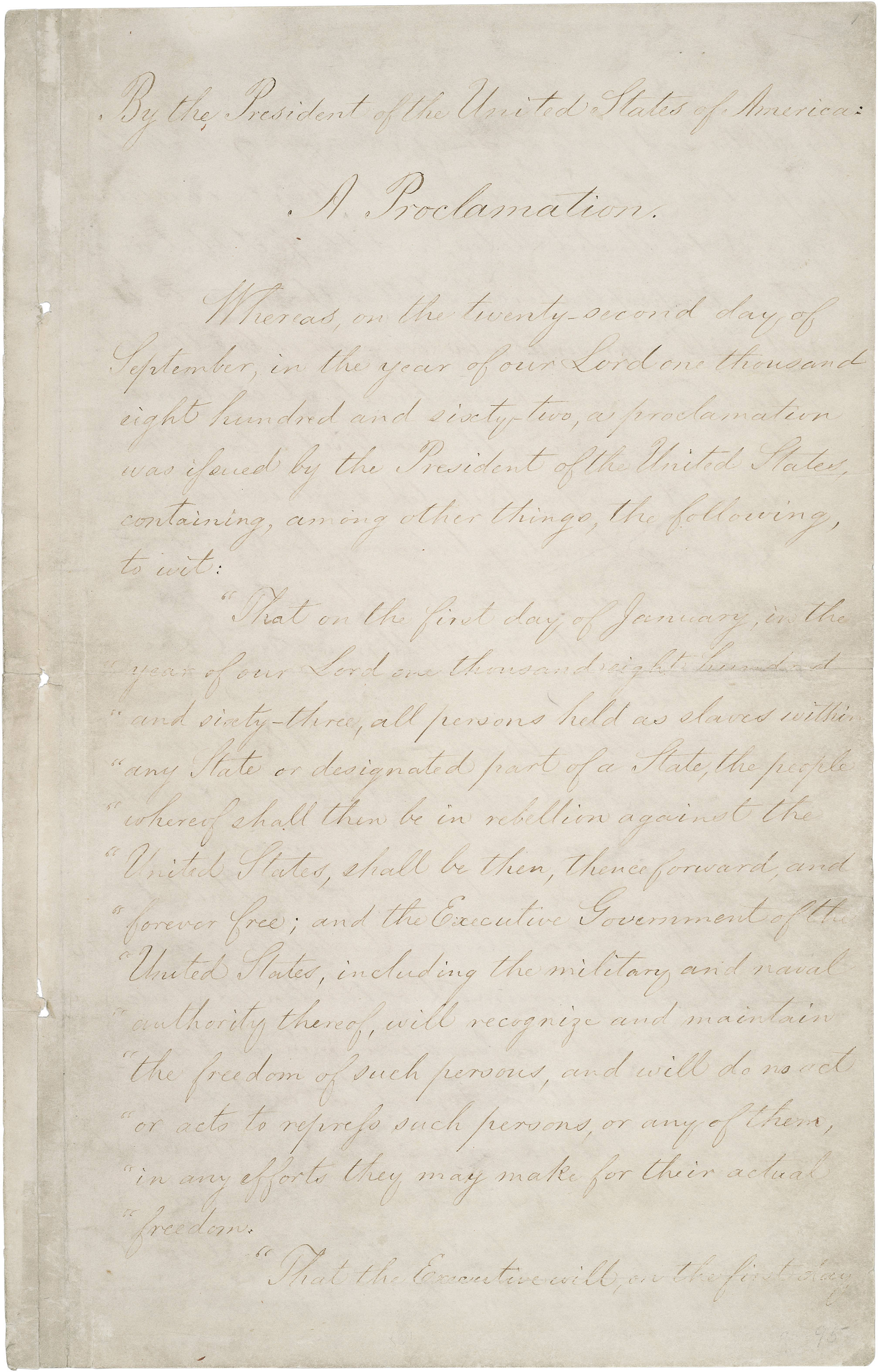
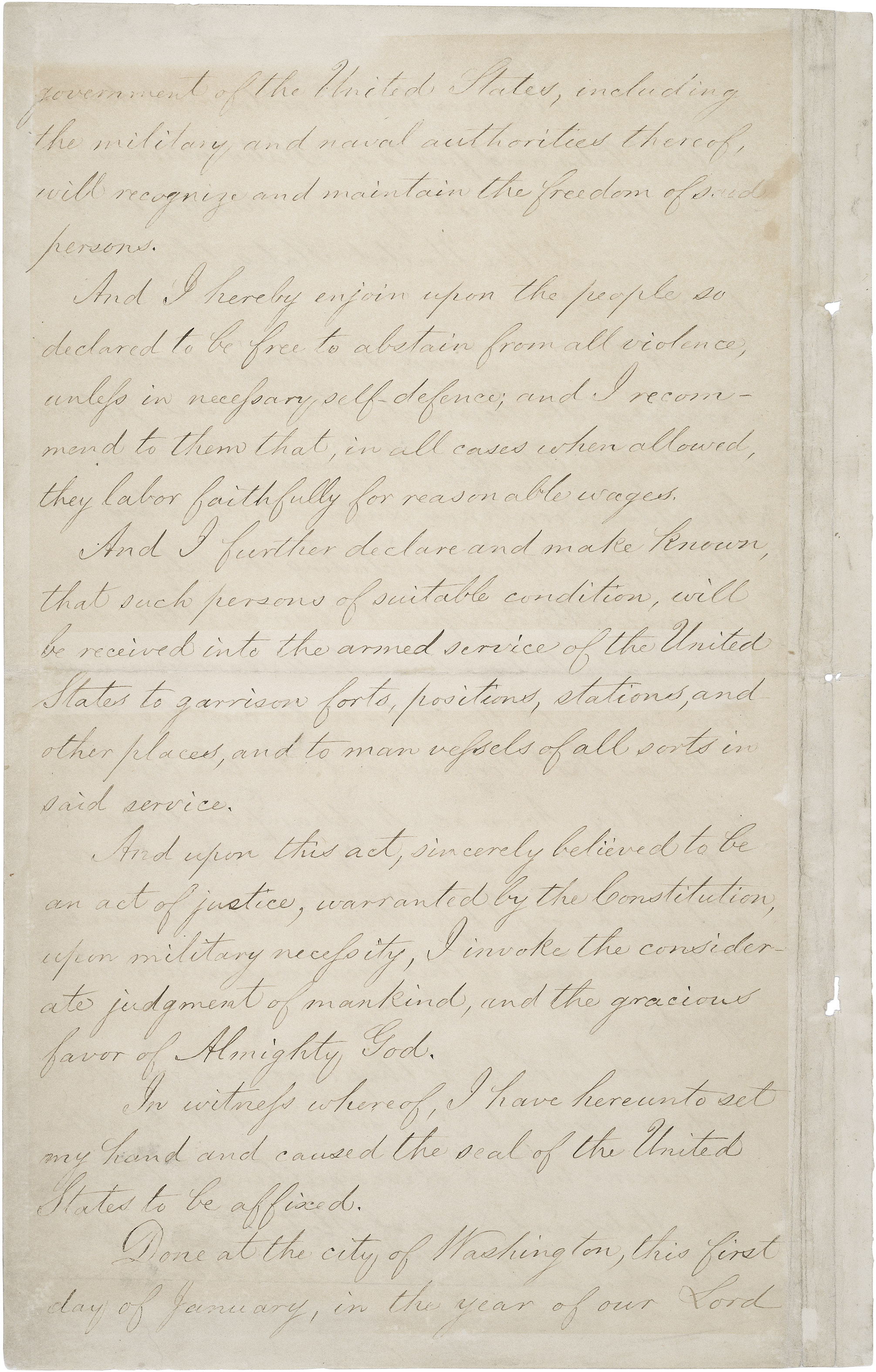
refer to caption The Emancipation Proclamation (page 1) Record Group 11 General Records of the United States
President Abraham Lincoln issued the Emancipation Proclamation on January 1, 1863, as the nation approached its third year of bloody civil war. The proclamation declared "that all persons held as slaves" within the rebellious states "are, and henceforward shall be free."
Despite this expansive wording, the Emancipation Proclamation was limited in many ways. It applied only to states that had seceded from the United States, leaving slavery untouched in the loyal border states. It also expressly exempted parts of the Confederacy (the Southern secessionist states) that had already come under Northern control. Most important, the freedom it promised depended upon Union (United States) military victory.
Although the Emancipation Proclamation did not end slavery in the nation, it captured the hearts and imagination of millions of Americans and fundamentally transformed the character of the war. After January 1, 1863, every advance of federal troops expanded the domain of freedom. Moreover, the Proclamation announced the acceptance of black men into the Union Army and Navy, enabling the liberated to become liberators. By the end of the war, almost 200,000 black soldiers and sailors had fought for the Union and freedom.
From the first days of the Civil War, slaves had acted to secure their own liberty. The Emancipation Proclamation confirmed their insistence that the war for the Union must become a war for freedom. It added moral force to the Union cause and strengthened the Union both militarily and politically. As a milestone along the road to slavery's final destruction, the Emancipation Proclamation has assumed a place among the great documents of human freedom.
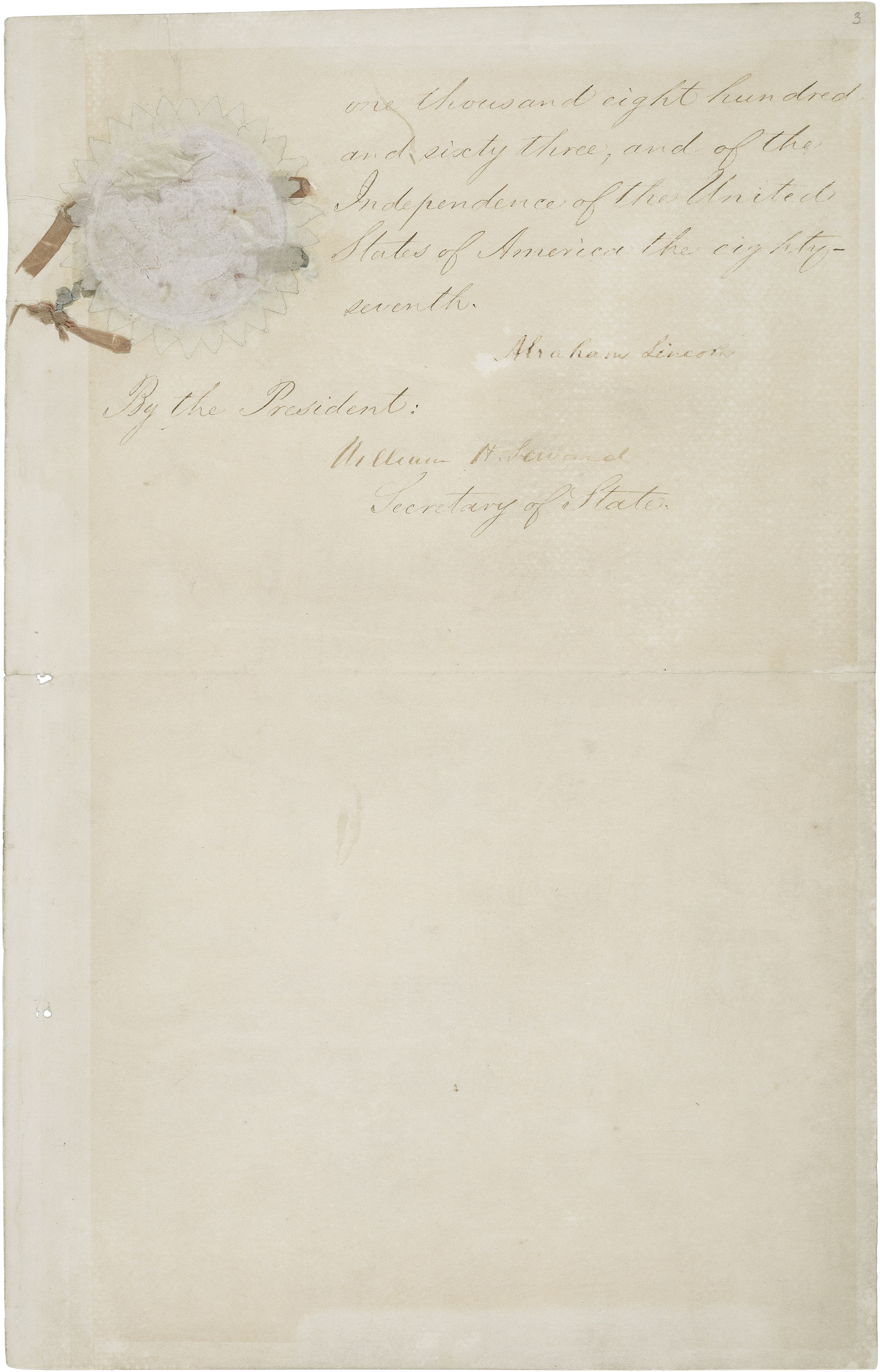
The original of the Emancipation Proclamation of January 1, 1863, is in the National Archives in Washington, DC. With the text covering five pages the document was originally tied with narrow red and blue ribbons, which were attached to the signature page by a wafered impression of the seal of the United States. Most of the ribbon remains; parts of the seal are still decipherable, but other parts have worn off.
The document was bound with other proclamations in a large volume preserved for many years by the Department of State. When it was prepared for binding, it was reinforced with strips along the center folds and then mounted on a still larger sheet of heavy paper. Written in red ink on the upper right-hand corner of this large sheet is the number of the Proclamation, 95, given to it by the Department of State long after it was signed. With other records, the volume containing the Emancipation Proclamation was transferred in 1936 from the Department of State to the National Archives of the United States.

The Emancipation Proclamation

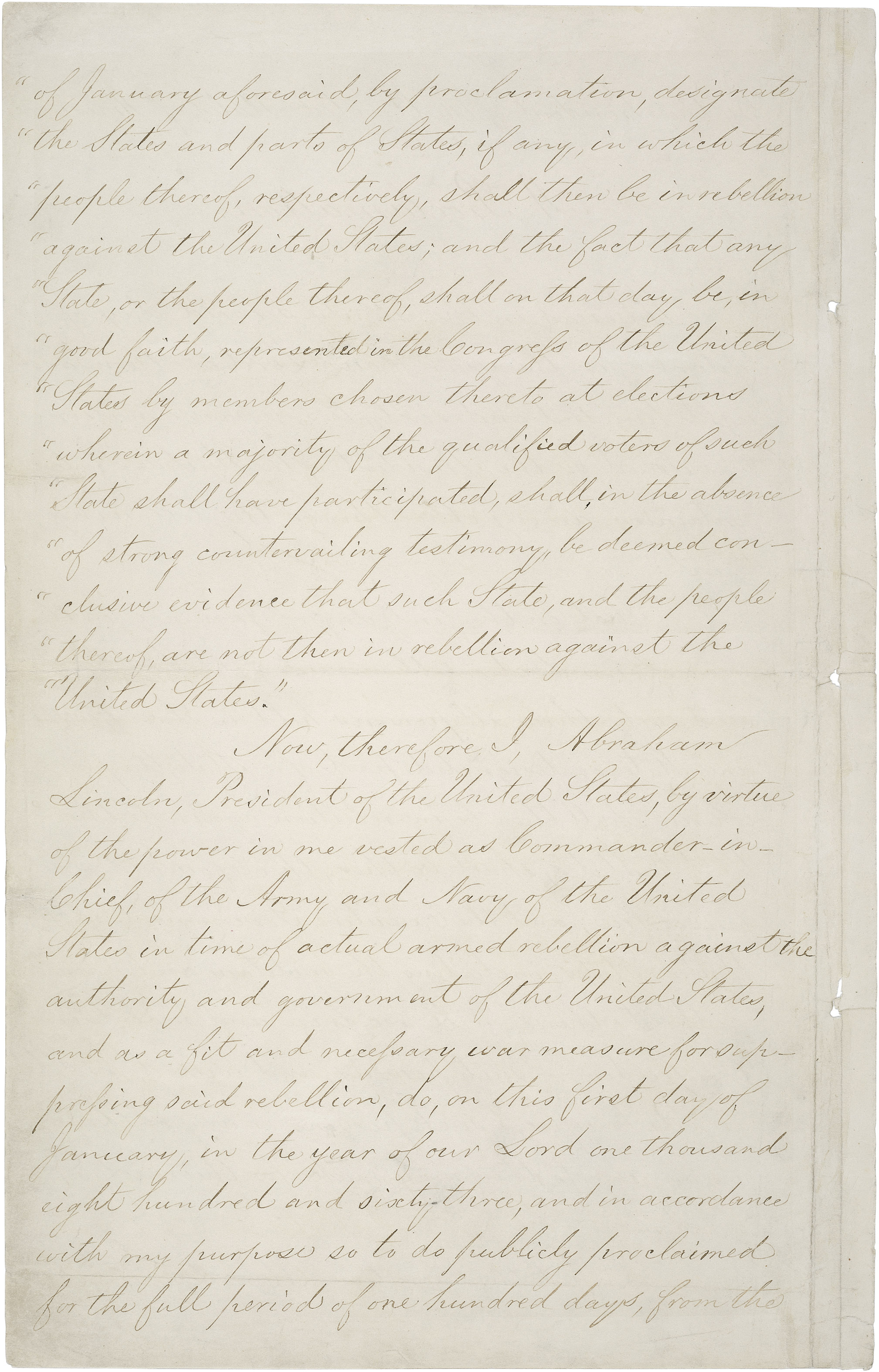
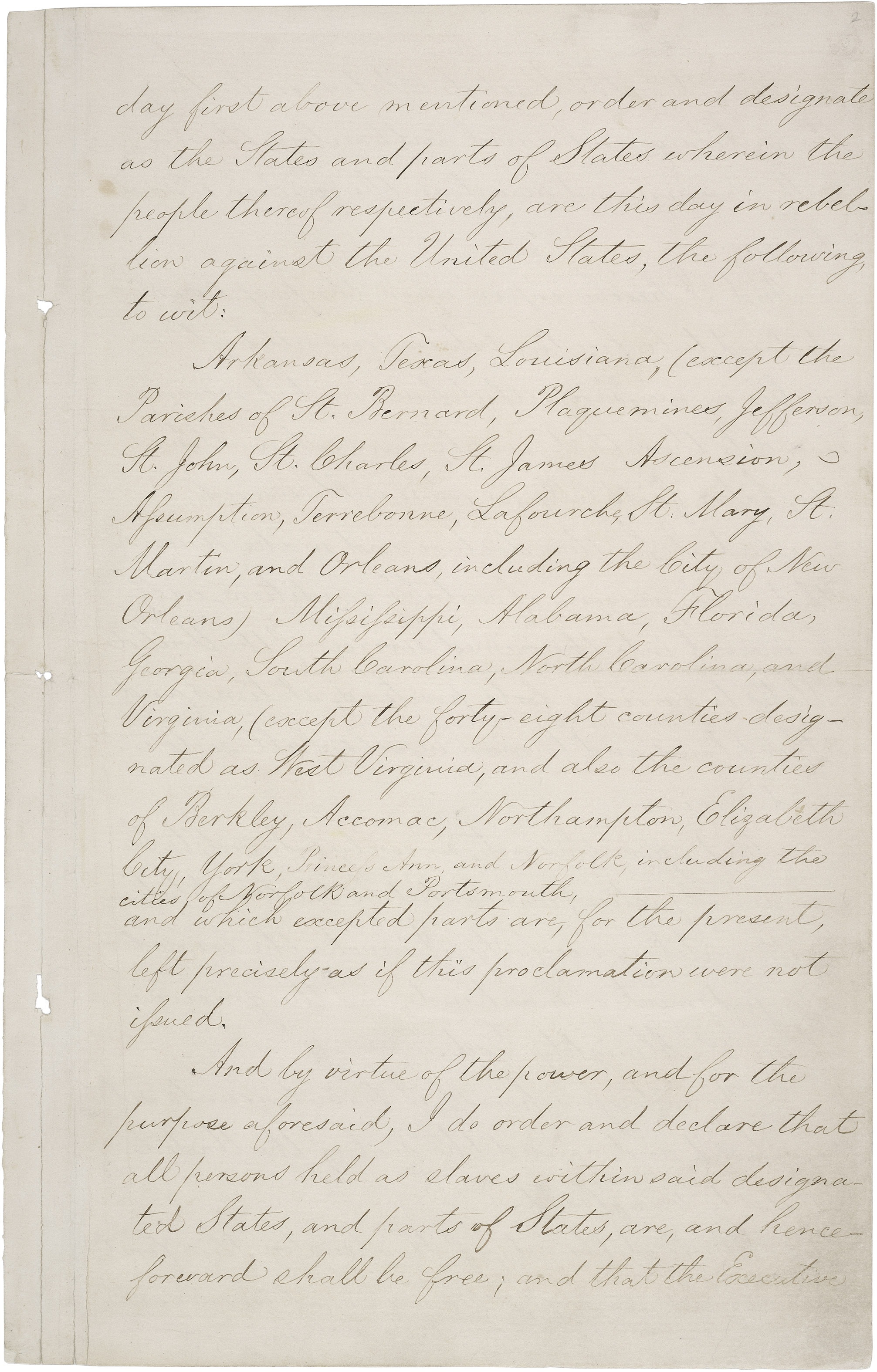
This is a copy of the original handwritten version of the

Emancipation Proclamation by Abraham Lincoln - 1862

refer to caption


page 1

refer to caption


page 2

refer to caption


page 3

refer to caption


page 4
refer to caption


page 5


Transcript of the Proclamation

January 1, 1863
A Transcription
By the President of the United States of America:
A Proclamation.
Whereas, on the twenty-second day of September, in the year of our Lord one thousand eight hundred and sixty-two, a proclamation was issued by the President of the United States, containing, among other things, the following, to wit:
"That on the first day of January, in the year of our Lord one thousand eight hundred and sixty-three, all persons held as slaves within any State or designated part of a State, the people whereof shall then be in rebellion against the United States, shall be then, thenceforward, and forever free; and the Executive Government of the United States, including the military and naval authority thereof, will recognize and maintain the freedom of such persons, and will do no act or acts to repress such persons, or any of them, in any efforts they may make for their actual freedom.
"That the Executive will, on the first day of January aforesaid, by proclamation, designate the States and parts of States, if any, in which the people thereof, respectively, shall then be in rebellion against the United States; and the fact that any State, or the people thereof, shall on that day be, in good faith, represented in the Congress of the United States by members chosen thereto at elections wherein a majority of the qualified voters of such State shall have participated, shall, in the absence of strong countervailing testimony, be deemed conclusive evidence that such State, and the people thereof, are not then in rebellion against the United States."
Now, therefore I, Abraham Lincoln, President of the United States, by virtue of the power in me vested as Commander-in-Chief, of the Army and Navy of the United States in time of actual armed rebellion against the authority and government of the United States, and as a fit and necessary war measure for suppressing said rebellion, do, on this first day of January, in the year of our Lord one thousand eight hundred and sixty-three, and in accordance with my purpose so to do publicly proclaimed for the full period of one hundred days, from the day first above mentioned, order and designate as the States and parts of States wherein the people thereof respectively, are this day in rebellion against the United States, the following, to wit:
Arkansas, Texas, Louisiana, (except the Parishes of St. Bernard, Plaquemines, Jefferson, St. John, St. Charles, St. James Ascension, Assumption, Terrebonne, Lafourche, St. Mary, St. Martin, and Orleans, including the City of New Orleans) Mississippi, Alabama, Florida, Georgia, South Carolina, North Carolina, and Virginia, (except the forty-eight counties designated as West Virginia, and also the counties of Berkley, Accomac, Northampton, Elizabeth City, York, Princess Ann, and Norfolk, including the cities of Norfolk and Portsmouth[)], and which excepted parts, are for the present, left precisely as if this proclamation were not issued.
And by virtue of the power, and for the purpose aforesaid, I do order and declare that all persons held as slaves within said designated States, and parts of States, are, and henceforward shall be free; and that the Executive government of the United States, including the military and naval authorities thereof, will recognize and maintain the freedom of said persons.
And I hereby enjoin upon the people so declared to be free to abstain from all violence, unless in necessary self-defence; and I recommend to them that, in all cases when allowed, they labor faithfully for reasonable wages.
And I further declare and make known, that such persons of suitable condition, will be received into the armed service of the United States to garrison forts, positions, stations, and other places, and to man vessels of all sorts in said service.
And upon this act, sincerely believed to be an act of justice, warranted by the Constitution, upon military necessity, I invoke the considerate judgment of mankind, and the gracious favor of Almighty God.
In witness whereof, I have hereunto set my hand and caused the seal of the United States to be affixed.
Done at the City of Washington, this first day of January, in the year of our Lord one thousand eight hundred and sixty three, and of the Independence of the United States of America the eighty-seventh.
By the President: ABRAHAM LINCOLN
WILLIAM H. SEWARD, Secretary of State.


The Emancipation Proclamation

An Act of Justice

Summer 1993, Vol. 25, No. 2

By John Hope Franklin

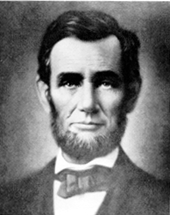
Abraham Lincoln President Abraham Lincoln (NARA, 64-M-163)

Thursday, January 1, 1863, was a bright, crisp day in the nation's capital. The previous day had been a strenuous one for President Lincoln, but New Year's Day was to be even more strenuous. So he rose early. There was much to do, not the least of which was to put the finishing touches on the Emancipation Proclamation. At 10:45 the document was brought to the White House by Secretary of State William Seward. The President signed it, but he noticed an error in the superscription. It read, "In testimony whereof I have hereunto set my name and caused the seal of the United States to be affixed." The President had never used that form in proclamations, always preferring to say "In testimony whereof I have hereunto set my hand. . . ." He asked Seward to make the correction, and the formal signing would be made on the corrected copy.

John Hope Franklin

The traditional New Year's Day reception at the White House began that morning at 11 o'clock. Members of the Cabinet and the diplomatic corps were among the first to arrive. Officers of the Army and Navy arrived in a body at half past 11. The public was admitted at noon, and then Seward and his son Frederick, the Assistant Secretary of State, returned with the corrected draft. The rigid laws of etiquette held the President to his duty for 3 hours, as his secretaries Nicholay and Hay observed. "Had necessity required it, he could of course have left such mere social occupation at any moment," they pointed out, "but the President saw no occasion for precipitancy. On the other hand, he probably deemed it wise that the completion of this momentous executive act should be attended by every circumstance of deliberation."
After the guests departed, the President went upstairs to his study for the signing in the presence of a few friends. No Cabinet meeting was called, and no attempt was made to have a ceremony. Later, Lincoln told F. B. Carpenter, the artist, that as he took up the pen to sign the paper, his hand shook so violently that he could not write. "I could not for a moment control my arm. I paused, and a superstitious feeling came over me which made me hesitate. . . . In a moment I remembered that I had been shaking hands for hours with several hundred people, and hence a very simple explanation of the trembling and shaking of my arm." With a hearty laugh at his own thoughts, the President proceeded to sign the Emancipation Proclamation. Just before he affixed his name to the document, he said, "I never, in my life, felt more certain that I was doing right than I do in signing this paper."
When I made my first serious study of this document, several copies of the December 30 draft were in existence. The copies of Cabinet officers Edward Bates, Francis Blair, William Seward, and Salmon P. Chase were in the Library of Congress. The draft that the President worked with on December 31 and the morning of New Year's Day is considered the final manuscript draft. The principal parts of the text are written in the President's hand. The two paragraphs from the Preliminary Proclamation of September 22, 1862, were clipped from a printed copy and pasted on to the President's draft, "merely to save writing." The superscription and the final closing are in the hand of a clerk in the Department of State. Later in the year, Lincoln presented his copy to the ladies in charge of the Northwestern Fair in Chicago. He told them that he had some desire to retain the paper, "but if it shall contribute to the relief and comfort of the soldiers, that will be better," he said most graciously. Thomas Bryan purchased it and presented it to the Soldiers' Home in Chicago, of which he was president. The home was destroyed in the Great Chicago Fire of 1871. Fortunately, four photographic copies of the original had been made. The official engrossed document is in the National Archives and follows Lincoln's original copy.
It is worth observing that there was no mention, in the final draft, of Lincoln's pet schemes of compensation and colonization, which were in the Preliminary Proclamation of September 22, 1862. Perhaps Lincoln was about to give up on such impracticable propositions. In the Preliminary Proclamation, the President had said that he would declare slaves in designated territories "thenceforward, and forever free." In the final draft of January 1, 1863, he was content to say that they "are, and henceforward shall be free." Nothing had been said in the preliminary draft about the use of blacks as soldiers. In the summer of 1862 the Confiscation Act had authorized the President to use blacks in any way he saw fit, and there had been some limited use of them in noncombat activities. In stating in the Proclamation that former slaves were to be received into the armed services, the President believed that he was using congressional authority to strike a mighty blow against the Confederacy.
It was late afternoon before the Proclamation was ready for transmission to the press and others. Earlier drafts had been available, and some papers, including the Washington Evening Star had used those drafts, but it was at about 8 p.m. on January 1 that the transmission of the text over the telegraph wires actually began.
Young Edward Rosewater, scarcely 20 years old, had an exciting New Year's Day. He was a mere telegraph operator in the War Department, but he knew the President and had gone to the White House reception earlier that day and had greeted him. When the President made his regular call at the telegraph office that evening, young Rosewater was on duty and was more excited than ever. He greeted the President and went back to his work. Lincoln walked over to see what Rosewater was sending out. It was the Emancipation Proclamation! If Rosewater was excited, the President seemed the picture of relaxation. After watching the young operator for a while, the President went over to the desk of Tom Eckert, the chief telegraph operator in the War Department, sat in his favorite chair, where he had written most of the Preliminary Proclamation the previous summer, and gave his feet the proper elevation. For him, it was the end of a long, busy, but perfect day.
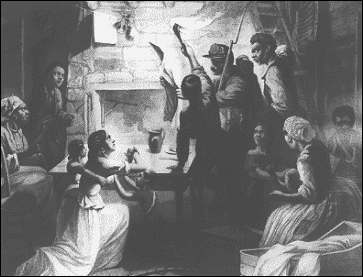
Image of a Union soldier reading the Proclamation to newly freed slaves
A Union soldier reads the Emancipation Proclamation to newly freed slaves. After Lincoln signed the Proclamation, celebrations took place throughout the country. (NARA, 79-CWC-3F8)
For many others in various parts of the country, the day was just beginning, for the celebrations were not considered official until word was received that the President had actually signed the Proclamation. The slaves of the District of Columbia did not have to wait, however, for back in April 1862 the Congress had passed a law setting them free. Even so, they joined in the widespread celebrations on New Year's Day. At Israel Bethel Church, Rev. Henry McNeal Turner went out and secured a copy of the Washington Evening Star that carried the text of the Proclamation. Back at the church, Turner waved the newspaper from the pulpit and began to read the document. This was the signal for unrestrained celebration characterized by men squealing, women fainting, dogs barking, and whites and blacks shaking hands. The Washington celebrations continued far into the night. In the Navy Yard, cannons began to roar and continued for some time.
In New York the news of the Proclamation was received with mixed feelings. Blacks looked and felt happy, one reporter said, while abolitionists "looked glum and grumbled . . . that the proclamation was only given on account of military necessity." Within a week, however, there were several large celebrations in which abolitionists took part. At Plymouth Church in Brooklyn, the celebrated Henry Ward Beecher preached a commemorative sermon to an overflow audience. "The Proclamation may not free a single slave," he declared, "but it gives liberty a moral recognition." There was still another celebration at Cooper Union on January 5. Several speakers, including the veteran abolitionist Lewis Tappan, addressed the overflow audience. Music interspersed the several addresses. Two of the renditions were the "New John Brown Song" and the "Emancipation Hymn."
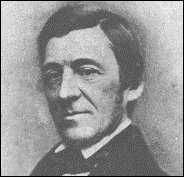
Ralph Waldo Emerson Ralph Waldo Emerson proclaimed, "Today unbind the captive," in his reading of the "Boston Hymn." (NARA, 111-BA-1113)
A veritable galaxy of leading literary figures gathered in the Music Hall in Boston to take notice of the climax of the fight that New England abolitionists had led for more than a generation. Among those present were John Greenleaf Whittier, Henry Wadsworth Longfellow, Oliver Wendell Holmes, Harriet Beecher Stowe, Francis Parkman, and Josiah Quincy. Toward the close of the meeting, Ralph Waldo Emerson read his "Boston Hymn" to the audience. In the evening, a large crowd gathered at Tremont Temple to await the news that the President had signed the Proclamation. Among the speakers were Judge Thomas Russell, Anna Dickinson, Leonard Grimes, William Wells Brown, and Frederick Douglass. Finally, it was announced that "It is coming over the wire," and pandemonium broke out! At midnight, the group had to vacate Tremont Temple, and from there they went to the Twelfth Baptist Church at the invitation of its pastor, Leonard Grimes. Soon the church was packed, and it was almost dawn when the assemblage dispersed. Frederick Douglass pronounced it a "worthy celebration of the first step on the part of the nation in its departure from the thraldom of the ages."
The trenchant observation by Douglass that the Emancipation Proclamation was but the first step could not have been more accurate. Although the Presidential decree would not free slaves in areas where the United States could not enforce the Proclamation, it sent a mighty signal both to the slaves and to the Confederacy that enslavement would no longer be tolerated. An important part of that signal was the invitation to the slaves to take up arms and participate in the fight for their own freedom. That more than 185,000 slaves as well as free blacks accepted the invitation indicates that those who had been the victims of thraldom were now among the most enthusiastic freedom fighters.
Meanwhile, no one appreciated better than Lincoln the fact that the Emancipation Proclamation had a quite limited effect in freeing the slaves directly. It should be remembered, however, that in the Proclamation he called emancipation "an act of justice," and in later weeks and months he did everything he could to confirm his view that it was An Act of Justice. And no one was more anxious than Lincoln to take the necessary additional steps to bring about actual freedom. Thus, he proposed that the Republican Party include in its 1864 platform a plank calling for the abolition of slavery by constitutional amendment. When he was "notified" of his renomination, as was the custom in those days, he singled out that plank in the platform calling for constitutional emancipation and pronounced it "a fitting and necessary conclusion to the final success of the Union cause." Early in 1865, when Congress sent the amendment to Lincoln for his signature, he is reported to have said, "This amendment is a King's cure for all the evils. It winds the whole thing up."
Despite the fact that the Proclamation did not emancipate the slaves and surely did not do what the Thirteenth Amendment did in winding things up, it is the Proclamation and not the Thirteenth Amendment that has been remembered and celebrated over the past 130 years. That should not be surprising. Americans seem not to take to celebrating legal documents. The language of such documents is not particularly inspiring, and they are the product of the deliberations of large numbers of people. We celebrate the Declaration of Independence, but not the ratification of the Constitution. Jefferson's words in the Declaration moved the emerging Americans in a way that Madison's committee of style failed to do in the Constitution.
Thus, almost annually--at least for the first hundred years--each New Year's Day was marked in many parts of the country by a grand celebration. Replete with brass band, if there was one, an African-American fire company, if there was one, and social, religious, and civic organizations, African Americans of the community would march to the courthouse, to some church, or the high school. There, they would assemble to hear the reading of the Emancipation Proclamation, followed by an oration by a prominent person. The speeches varied in character and purpose. Some of them urged African Americans to insist upon equal rights; some of them urged frugality and greater attention to morals; while still others urged their listeners to harbor no ill will toward their white brethren.
As the 50th anniversary of the Proclamation approached, James Weldon Johnson, already a writer of some distinction, was serving a tour of duty as U.S. Consul in Corinto, Nicaragua. His biographer, Eugene Levy, tells us that Johnson for some time had considered writing a poem commemorating the 50th anniversary of the Emancipation Proclamation. In September 1912, when he read of the ceremonies marking the Preliminary Proclamation, he realized that he had only 100 days in which to write the poem. Using all of his spare time, of which there was little, Johnson hammered out "Fifty Years." There was not enough time to publish it in one of the major literary monthly journals, so he turned to the New York Times, which published it on its editorial page on January 1, 1913.
Addressing his fellow African Americans in the first stanzas, Johnson said:
O Brothers mine, to-day we stand
Where half a century sweeps our ken,
Since God, through Lincoln's ready hand,
Struck off our bonds and made us men. Just fifty years--a winter's day--
As runs the history of a race;
Yet, as we look back o'er the day,
How distant seems our starting place!
Then, in a more assertive tone, making certain that humility did not replace self-confidence, he said:
This land is ours by right of birth,
This land is ours by right of toil
We helped to turn its virgin earth,
Our sweat is in its fruitful soil.
To gain these fruits that have been earned,
To hold these fields that have been won,
Our arms have strained, our backs have burned,
Bent bare beneath a ruthless sun.
Then should we speak but servile words,
Or shall we hang our heads in shame?
Stand back of new-come foreign hordes,
And fear our heritage to claim?
No! stand erect and without fear,
And for our foes let this suffice--
We've bought a rightful sonship here,
And we have more than paid the price. . . .
That for which millions prayed and sighed
That for which tens of thousands fought,
For which so many freely died,
God cannot let it come to naught.
In the second half of the Proclamation's first century, the annual celebrations diminished in extent as well as in fervor. Some celebrants, with an eye on a quick buck, began to promote June 19, the day on which President Lincoln signed a bill abolishing slavery in the territories. The bill did not apply to Texas, which was a state in the Confederacy, but slick promoters there soon drew attention to that day and persuaded Texans, Oklahomans, and others in the Southwest that this was indeed the day of emancipation. It was never quite clear to me, moreover, why we in Oklahoma celebrated August 4 as well as Juneteenth and January 1, but clearly the summer months had many advantages over a January observance.
Something else was diluting the celebrations of the anniversary of the Emancipation Proclamation. It was bad enough that a casual reading of the Proclamation made clear that it did not set the slaves free. It was also clear that neither the Reconstruction amendments nor the legislation and Executive orders of subsequent years had propelled African Americans much closer to real freedom and true equality. The physical violence, the wholesale disfranchisement, and the widespread degradation of blacks in every conceivable form merely demonstrated the resourcefulness and creativity of those white Americans who were determined to deny basic constitutional rights to their black brothers.
Several years before 1963, the National Association for the Advancement of Colored People began to use the motto "Free by '63." Other groups adopted the motto and focused more attention on the drive for equality. Many leaders were especially sensitive to the significance of the Emancipation Centennial in pointing up racial inequality in American life. On September 22, 1962, when Governor Nelson Rockefeller of New York spoke in Washington to mark the opening of the exhibit of the Preliminary Proclamation, "the state's most treasured possession," he said, "the very existence of the document stirs our conscience with the knowledge that Lincoln's vision of a nation truly fulfilling its spiritual heritage is not yet achieved."
During the centennial year itself, the United States Commission on Civil Rights presented to the President a report on the history of civil rights, most of which I wrote on contract with the Commission. Knowing that I would be out of the country during most of the centennial year, I published my history of the Emancipation Proclamation as my contribution to the observance.* On Lincoln's birthday in 1963, President and Mrs. Kennedy received more than a thousand black and white citizens at the White House and presented to each of them a copy of the report of the Civil Rights Commission, called Freedom to the Free. Speaking at Gettysburg later that year, Vice President Lyndon B. Johnson said, "Until justice is blind, until education is unaware of race, until opportunity is unconcerned with the color of men's skins, emancipation will be a proclamation but not a fact." President Kennedy took note of the absence of equality when he said, "Surely, in 1963, 100 years after emancipation, it should not be necessary for any American citizen to demonstrate in the streets for an opportunity to stop at a hotel, or eat at a lunch counter . . . on the same terms as any other customer."
Although it is now possible for most African Americans to eat at a lunch counter in most parts of the United States, the extension of these civilities has been accompanied by subtle, yet barbarous forms of discrimination. These forms extend from redlining in the sale of real estate to discrimination in employment to the maladministration of justice. In issuing the Emancipation Proclamation and wording it as he did, Lincoln went as far as he felt the law permitted him to go. In subsequent months he went a bit further, inch by inch, until before his death he was calling for the enfranchisement of some blacks. The difference between the position of Lincoln in 1863 and Americans in 1993 is that our leaders in high places seem not to have either the humanity or the courage of Lincoln. The law itself is no longer an obstruction to justice and equality, but it is the people who live under the law who are themselves an obvious obstruction to justice. One can only hope that sooner rather than later we can all find the courage to live under the spirit of the Emancipation Proclamation and under the laws that flowed from its inspiration.
This essay is based on a talk given by John Hope Franklin at the National Archives, January 4, 1993, on the occasion of the 130th anniversary of the signing of the Emancipation Proclamation.


*The Emancipation Proclamation (Garden City, NW: Doubleday and Company, 1963; reprint, Arlington Heights, IL: Harlan Davidson, Inc., 1994).
John Hope Franklin has taught at Fisk University, the University of Chicago, and most recently, Duke University, where he is James B. Duke Professor of History Emeritus. Past president of the American Historical Association and the Society of Phi Beta Kappa, his publications include From Slavery to Freedom (1947), The Emancipation Proclamation (1963), and Race and History: Selected Essays, 1938-1988 (1990). 

NOTE:  John Hope Franklin was born in Rentiesville, Oklahoma - an All Black Town -which still exists today as one the 13 remaining of 67 originally All Black Towns - GDW 02/12/2020

Articles published in Prologue do not necessarily represent the views of NARA or of any other agency of the United States Government.

NATIONAL ARCHIVES AND RECORDS ADMINISTRATION
The Emancipation Proclamation, 1863
"When you are dead and in Heaven, in a thousand years that action of yours will make the Angels sing your praises."
Hannah Johnson, mother of a Northern Black soldier, writing to President Abraham Lincoln about the Emancipation Proclamation, July 31, 1863
President Abraham Lincoln issued the Emancipation Proclamation on January 1, 1863, as the nation approached its third year of bloody civil war. The proclamation declared "that all persons held as slaves" within the rebellious states "are, and henceforward shall be free."
Despite that expansive wording, the Emancipation Proclamation was limited in many ways. It applied only to states that had seceded from the Union, leaving slavery untouched in the loyal border states. It also expressly exempted parts of the Confederacy that had already come under Northern control. Most important, the freedom it promised depended upon Union military victory.
Although the Emancipation Proclamation did not immediately free a single slave, it captured the hearts and imagination of millions of African Americans, and fundamentally transformed the character of the war from a war for the Union into a war for freedom. Moreover, the proclamation announced the acceptance of black men into the Union army and navy, enabling the liberated to become liberators. By the end of the war, almost 200,000 black soldiers and sailors had fought for the Union and freedom.
For more about the Emancipation Proclamation please visit: Emancipation Proclamation


DISTRICT OF COLUMBIA EMANCIPATION ACT APRIL 12, 1862
https://www.archives.gov/exhibits/featured-documents/dc-emancipation-act
 
 
THERE IS SO MUCH TO LEARN AND UNDERSTAND ABOUT OUT HISTORY - THE TRIALS, TRIBULATIONS, TRAGEDIES AND TRIUMPHS - We have to do our own homework - but after you learn it, do like Carter G. Woodson, Frederick Douglass, Booker T. Washington, John Henrick Clarke, and so many others and teach your children and other family members and neighbors.  Don't allow their distortions or our ignorance to continue.
 
 
NOW THAT YOU KNOW
WHAT ARE YOU GOING TO DO ABOUT IT?
 
 
Stay Blessed & 
ECLECTICALLY BLACK 
Gloria Dulan-Wilson


-->

10.26.2014

Response to The BlackLists' Article: "Ebola – Open Letter to the ECOWAS presidents"

By Gloria Dulan-Wilson


I'm glad someone is addressing the ECOWAS Presidents about the seeming Ebola pandemic.   For those who are not familiar, ECOWAS is the Economic Community of West African States, and is comprised of: Benin, Burkina Faso, Cape Verde, Gambia, Ghana, Guinea, Guinea-Bissau, Ivory Coast, Liberia, Mali, Niger, Nigeria, Senegal, Sierra Leone, and Togo.

However, regardless of whether this virus is natural or man made, people are dying - a cure and preventative measures must be developed ASAP!!
 
My query is whether or not Africa has the appropriate research laboratories to make this happen?  Do they have the appropriate medical personnel and research technicians to bring this to fruition?  If not, then they should be partnering with Japan, not the euro-centric powers to find the cause/cure - they're more thorough.  The Cuban medical field is also a great resource - having already sent 461 doctors to Africa to help with prevent further spread of the disease and deaths, they also have very advanced medical technicians who may be instrumental in finding a cure.

Step out of the neo-colonial dependency box and begin to develop your own autonomous sources and resources.   This is the opportune time to clean up those places in Africa that harbor bacteria and viruses; begin to teach the people preventative measures, while simultaneously developing your own internal autonomous economies to support yourself without dependence or eruoamerican funding sources. 

Africa has all the natural resources it needs - and some of the best educated and brightest minds, as well.  Now is the time to put them to good use. 

I pray for my brothers and sisters - that they are able to stem the tide of this epidemic; but I also hope this is the beginning of the United Continent of Africa where you turn to each other and not on each other.  You've got oil, diamonds, gold, and other natural mineral, vegetable, and animal resources in abundance; you have some of the smartest people on the planet.  Stop looking at this as a matter of condemnation, and view it from an opportunity to put in place those measures that would transform Africa into a more modern, yet humane, developed, yet communalistic, continent where all our Black brothers and sisters can live, thrive and grow.

Also remember, it wasn't until England and America faced these very same kinds of pandemics that they began to clean up their communities, educate the people, develop better health measures and laws, and come up with the medical and physical preventatives to the diseases out.  Their own scientists began doing research to come up cures for polio, smallpox, chicken pox, measles, cholera and a whole host of other diseases. 

Africa can do the same and develop the same measures - and better. 

Stay Blessed & ECLECTICALLY BLACK -

MUNGU IBARITI AFRICA SASA HIVI!
    (God Bless Africa Right Now - Swahili)

Gloria Dulan-Wilson


Ebola – Open Letter to the ECOWAS presidents  by Chinweizu

AS the spectre of Ebola stalks the world, people everywhere are looking accusingly at the ECOWAS presidents. Like the commandants from whose prison a jailbreak of very dangerous prisoners has just happened, they had better have a damned good explanation of the event or face court martial, etc. The citizens of ECOWAS demand no less. How can these presidents allow such a thing to happen on their watch and disgrace all Africans?  Aspersions of all sorts are being cast on us as incompetent to manage our countries.

Africa is being demonized as this mysterious human backwater from which strange diseases emerge to afflict the whole world. Before long it will be argued that Africa should be re-colonized by the West to protect the whole world from the deadly incompetence of its corrupt black misrulers.


President Goodluck Jonathan

President Goodluck Jonathan - NIGERIA
~
Cancellation of conferences

In the meantime, the economies of ECOWAS countries are suffering. Their tourism sector has already been hit by postponement and cancellation of conferences, group tours, private visits etc. In farming villages economic activities are being disrupted as the people flee for safety.

And when the entry bans being urged in the USA and elsewhere are imposed, there will also be the cost of social disruption as family members, barred from entry into America and Europe, cannot visit one another. Students back home on vacation may not be able to return to their campuses abroad, nor will importers be able to make quick trips abroad to buy and bring in goods.

Emergency trips abroad for treatment of other ailments will be affected. Until the epidemic is ended, the economies of ECOWAS will be seriously hit and the economic and social coats will keep mounting. And the epidemic can’t be ended without knowing its causes and therefore the effective ways to combat them.

After all, if you don’t understand it you can’t fix it. I, as a concerned ECOWAS citizen— and I believe many other Africans would join me in this—therefore demand an emergency ECOWAS Summit on Ebola at which the ECOWAS presidents should set up a public and independent Commission of Enquiry comprising eminent international judges and jurists to investigate the event and find answers to some pertinent questions:

On February 18, 2006, I delivered a public lecture at Muson Centre, Lagos, titled “Lugardism, UN Imperialism and the prospect of African power.” In it I mentioned a book, published in 1997, whose title should be the starting point of discussions on how to contain and end the Ebola epidemic of 2014. It was Emerging Viruses: AIDS & Ebola – Nature, Accident or Intentional? by Dr. Len Horowitz , (Tetrahedron, LLC., 1997; ISBN:092355012-7;$29.95)

That title, from nearly twenty years ago, suggested that AIDS and Ebola may not be natural viruses, but lab-made viruses. For the purposes of investigating this Ebola epidemic, and until a better hypothesis is offered, let’s start with the hypothesis that this Ebola epidemic has been caused by a lab-made virus.

Virus epidemics
If it is a lab-made virus, then how come it is now suddenly proliferating in West Africa, in the Mano River basin countries (Liberia, Sierra Leone and Guinea)?  How many genetic engineering labs using recombinant technology are there in those countries? Who operates them?  That’s where, in my view, the ECOWAS Presidents should begin their inquiries if they want to protect their populations from this and similar virus epidemics in future.

Here are some of the pertinent questions to be put to the proposed ECOWAS Commission:
  • Is the Ebola virus natural or artificial, i.e. lab-made? Logically, it is either natural or artificial.
    John Dramani Mahama Ghana's new President
                 President John Dramani Mahama  GHANA 

Here is an editorial in The Observer (London), Sunday, October 5, 2014, telling of the first death in this epidemic: “On December 26, 2013, a two-year-old boy fell sick with a mysterious illness whose symptoms local people and medical workers had never seen before. Within two days, the boy was dead.”

This suggests that it was not something previously known in the area. Hence it could not have been naturally present or endemic in that ecosystem. If it were a natural and therefore ancient member of the ecosystem of the Mano River basin, it would have manifested there long enough before now for the local population to have developed some immunity to it and to have knowledge of it – as with malaria. Ergo, it is a recent introduction to the area. And it is probably an artificial virus.
  • If Ebola is a lab-made virus, who manufactures it?
  • Is there any patent on the Ebola virus? If so, who owns the patent?
  • Who brought the virus to the Mano River Union countries (Sierra Leone, Liberia and Guinea) and in sufficient quantities to infect so many as to have killed some 3000 in the ten months since that first death in December 2013?
  • Have any labs in those countries been working on Ebola?
  • If yes, who set them up and who operates them?
  • Where precisely are they located?
  • How did the virus get from the labs to the village where the boy lived?
  • Was the escape to that village accidental or intentional?
Some other intriguing questions that ECOWAS presidents should direct the Commission to investigate include:
  • Is it true that researchers from Tulane University, New Orleans, USA, have been operating in the area for about ten years under the leadership of one Dr. Robert Garry, Professor of Microbiology and Immunology at Tulane University School of Medicine?
  • Have they been conducting any experimental treatments on citizens of the region (e.g., injecting monoclonal antibodies)?
  • What are the declared purposes of the Tulane University research project?
  • Do they include detecting the possible use of hemorrhagic fever viruses as bioweapons?
  • Have they also been investigating the use of monoclonal antibodies as a treatment for Lhasa fever and other viral hemorrhagic fevers?
  • If so where? On-site in Africa or outside Africa?

  • SIRLEAF
              President SIRLEAF  - LIBERIA
  • What treatments have such investigations produced for Ebola?
  • Have these treatments been made available to the Ebola victims in West Africa? And how soon after the epidemic began?
  • What precise roles have Dr. Robert Garry, Professor of Microbiology and Immunology, and Dr. James Robinson, Professor of Pediatrics, been playing in this research?
  • What do Profs Garry and Robinson have to say about the origins of this epidemic?
  • What role has Corgenix Medical Corp been playing in the Tulane research?
  • What does Douglass Simpson, president of Corgenix, have to say about the origins of this epidemic?
  • Are any US Government agencies or UN agencies associated with Tulane University in this research?
  • What role has the World Health Organization been playing in the Tulane University research?
  • Who funds this Tulane University research project?
  • Is it true that the Cubans sent help before the UK and USA? If so, How come the big countries were tardy?
  • Did the governments of the affected countries (Liberia, Sierras Leone and Guinea) sign agreements permitting the research and trials in their territory?
  • Were any risk assessments done before the arrangements were agreed?
  • Were they given financial incentives/ rewards to allow the research?
  • Did they clear these arrangements with the other ECOWAS countries?
  • Are these governments in any economic arrangements with China?
  • These are 30 pertinent questions. Let an ECOWAS Commission of eminent jurists be set up, and let them help a frightened world to find and listen to the evidence.
Artificial Ebola virus
If the ECOWAS investigation upholds the hypothesis that the Ebola virus is lab-made and new to the ecosystem of the Mano River basin, then whoever they were that brought this artificial Ebola virus to West Africa are prima facie responsible for causing this epidemic.  And they have a legal and moral obligation to supply any cures they have developed and in sufficient quantities to eradicate the epidemic within a month.

The fearful citizens of ECOWAS, the fearful people of Africa, indeed the fearful people of the whole world need answers to these questions. And it is the responsibility of the ECOWAS presidents to
    start providing the answers without delay.


                       Chinweizu

The whole world is frightened; the whole world is waiting! The whole world is watching and judging them. Let them not, by inaction or delay, convict themselves of indifference or incompetence or worse.
    http://www.vanguardngr.com/2014/10/ebola-open-letter-ecowas-preside...
    From:  Chinweizu Chinweizu
    Sent: Sat 10/25/14 4:16 PM
    Ebola – Open Letter to the ECOWAS presidents


    There have been statements that the US has a patent on the Ebola virus - which may or may not be true.  The first epidemic of Ebola broke out over 20 years ago in parts of Africa, and either was subsequently contained, or cured - there appears to be no record of how the first outbreak started, or what stopped it.  It's time to revisit that as well. 

    But while Chinweizu's  30 questions are being pondered, the first and foremost concern has to be WHAT IS THE CURE, HOW DO WE GET IT; AND HOW BEST TO ADMINISTER IT TO OUR PEOPLE?


    STAY BLESSED

    -->

    8.07.2014

    EBOLA: Some think it a conspiracy of the US against Africa - Really???

    By Gloria Dulan-Wilson

    I find it interesting that there are those who think the Ebola outbreak, and the efforts to curb and cure it, are an American plot to control Africa.  I received this from a friend, and just wonder how far we take our mistrust when it comes to the health and well being of our loved ones - our people?  

    This is her commentary on the article below, and my response to that commentary follows.  While I'm not sharing her name, because she is a friend of mine, I am sharing her statement:
    "You are always on it Nana! This is another fake ploy to round people up and you know who it's going to be -- US!  I will NOT take an ebola vaccine. Folks think this is a joke, but these devils are serious and Obama is enabling it. He re-upped the Patriot Act 1 & 2 twice since he's been in office so don 't be fooled.  Y'all better get a copy and read it. It's online. Everything is not what it seems and everyone who looks like us ain't one of us. People better be very aware and don't fall for the okey doke because we have a "Black-looking" president.  The Orisa warns about this stuff in the reading of the year and beyond. KEEP YA EYES OPEN! read below"
    In addition to finding the characterization of President Obama extremely offensive, I am taking this opportunity to say to my African and African American brothers and sisters, that in the past, whether here in the US, in Africa, in other parts of the world, when life threatening diseases have broken out, for whatever reason, from whatever source, the President has to take broad and sweeping measures to protect US citizens.  Likewise, the medical community has the responsibility of not only curing the people who have been infected with it (if there is a cure), but protecting the rest of the people from being affected by it.   Reading anything else into it, especially pertaining to President Obama, is a special form of paranoia that needs to be examined. 

    The Model State Emergency Health Powers Act,  gives governors broad powers to protect their citizens.  It's also called  QUARANTINE.  That means if it broke out in your block, in your house, you cannot leave your house or your block and spread it to other people.  That means you are on lockdown. And the government has the right and the power to impose this on you and your family until and unless it is proven that you are not a CARRIER of the disease.  It does not make the governor a dictator; it expands what he/she can do to prevent the spread of deadly diseases.  And it's not new.  It started with TYPHOID MARY, who it turned out, was a carrier of Typhoid Fever, which killed thousands of New Yorkers - even though she herself never became ill with it.  She cooked for a family, was infected with the virus, the whole family was wiped out.  It took serious investigation before they were able to isolate it to this lady.    In the interim, she was traveling on public transportation, eating in restaurants, etc., unaware that she was infecting people.

    It's also what happened (until the found a cure) with measles, mumps, diptheria, chickenpox, small pox, etc.    You isolate the people who are infected until they are cured.  You make sure they do not contaminate others.  This is not a governmental conspiracy - it's the government acting responsibly to ensure that it does not wipe out whole populations.  

    That said, the following article, to which my friend refers in her statement, is a sad statement of the serious problems health organizations face as they try to assist in stemming the spread of this epidemic through Africa, and simultaneously prevent its entre into the US.  When it comes to my health and well being, I will err on the side of the government.  As far as vaccines go, they are the reason why so many of the diseases no longer exist in the US.  Had scientists and the medical industry not been diligently researching and looking for a cure, we'd still be plagued with many of these diseases.  So when someone refuses to be innoculated, it's as though they're setting up their own deathwish.  So be it, as long as they're not spreading anything to me or mine.  Simultaneously, I pray that the vaccine to cure those who are afflicted, and prevents those who are still healthy from getting it, proves to be efficacious.   I find articles like this below to be unhelpful, and, well, ignorant.  

    As I said, I am praying  for my brothers and sisters in Liberia, Sierra Leone, Guinea and any other places where this vile disease may be.

    Stay Blessed & 
    ECLECTICALLY BLACK
    Gloria

    EBOLA OUTBREAK - Is it a FALSE FLAG ATTACK?


    A Liberian health official says the Ebola outbreak is now above the control of its government.

    “Our government has declared this now as a humanitarian crisis that is above the control of the national government,” Tolbert Nyenswah, Liberia’s assistant minister of health, told CBS News.

    More than 700 people have died in four western African nations during the largest Ebola outbreak ever, with over 320 known cases in Liberia alone. One American died while contracting the virus in Liberia. Two other American medical missionary workers also contracted Ebola.

    Model State Emergency Health Powers Act "could turn governors into dictators" Federal health authorities could exercise authoritarian powers to control an Ebola outbreak if the deadly disease hits the United States under the Model State Emergency Health Powers Act, legislation passed in the wake of 9/11 which attracted controversy at the time for its draconian scope.
    With the Ebola outbreak in West Africa having been declared the worst in history by the World Health Organization, concerns are mounting that the disease could spread via international air travel. Asked whether the virus could arrive in the United States, CNN Chief Medical Correspondent Dr. Sanjay Gupta said, “It’s going to happen at some point.”

    The Model State Emergency Health Powers Act, drafted during the 2001 anthrax attacks, has since been adopted in whole or in part by 33 states. The Association of American Physicians and Surgeons warned that the legislation “could turn governors into dictators,” while constitutional lawyer Phyllis Schlafly labeled it “an unprecedented assault on the constitutional rights of the American people.”
    Truth Raider Warns of Ebola False Flag .The federal government already has the authority to round people up against their will. Ebola Vaccines: Poor Market Potential and Lack of Subjects for Clinical Trials Holding Up Testing The most promising one is stuck in safety testing for the simple reason there is no money for a vaccine that has no market. Most big pharmaceuticals do not like to sink assets into developing any drug with low potential. That leaves the playing ground largely to the government and small, niche companies.

    Western governments are now issuing alerts to doctors to be on the lookout for symptoms of the disease after an infected Liberian man was found to have traveled through a major transport hub in Nigeria. The World Health Organization has called the outbreak the worst on record, while Doctors Without Borders says the situation is “out of control.”

    Back in April, the Department of Defense announced that it had deployed biological diagnostic systems to National Guard support teams across the U.S. in readiness for any potential Ebola outbreak.
    An NHS doctor has urged the world to wake up to the growing threat of Ebola after risking his life working 24-hour hospital shifts trying to save pregnant women struck down by the disease.

    If the worst Ebola outbreak in recorded history reaches the United States, federal law permits “the apprehension and examination of any individual reasonably believed to be infected with a communicable disease”. These individuals can be “detained for such time and in such manner as may be reasonably necessary”. In other words, the federal government already has the authority to round people up against their will, take them to detention facilities and hold them there for as long as they feel it is “reasonably necessary”. In addition, as you will read about below, the federal government has the authority “to separate and restrict the movement of well persons who may have been exposed to a communicable disease to see if they become ill”. If you want to look at these laws in the broadest sense, they pretty much give the federal government the power to do almost anything that they want with us in the event of a major pandemic. Of course such a scenario probably would not be called “marital law”, but it would probably feel a lot like it.


    You might also like:
    Posted By Blogger to Nana's Rants on Subjects from A-Z at 8/03/2014 10:24:00 PM

    There are doctors, nurses and volunteers who are trying to fight this scourge that appears to be spreading in parts of Africa - we cannot naively allow ourselves to be persuaded that this is some kind of government attempt to contain people.  When people's lives are at stake, we need to be doing all that we can to help - physically, medically, materially, spiritually.

    God protect the people from any further contamination or death from the ebola virus, or any other diseases - Amen!

    Stay Blessed &
    ECLECTICALLY BLACK
    Gloria Dulan-Wilson
     

    -->