Well, this is not at all how we want to start our Sunday, or our week; but we have to deal with the fact that the spectre of Covid-19 still looms large over New York, as well as America. Sadly, much of it is the result of blatant disregard for the guidelines that were outlined by both Governor Cuomo and Mayor DeBlasio. This has precipitated an uptick in contamination, which they hope they will be able to stem before it reaches the horrific proportions experienced in the early stages of the pandemic, causing the loss of thousands of lives of New Yorkers - not to mention jobs, unemployment, and peace of mind. I am sending up a prayer for my fellow New Yorkers - as well as all those who have been inflicted or infected by this horrific virus. Stay Blessed - GDW
New York to ‘Rewind’ Re-Opening in Hard-Hit Neighborhoods
Mayor
Bill de Blasio of New York announced plans to close nonessential
businesses, schools and day care centers in nine neighborhoods where the
coronavirus testing positivity rates have been higher than 3 percent in
the past 7 days.
I’m
going to be giving an update that gives me no joy at all. In fact, it
pains me to be putting forward this approach that we’ll need. But in
some parts of our city, in Brooklyn and Queens, we’re having an
extraordinary problem, something we haven’t seen since the spring. And
we have to address this issue forthrightly. That’s why we’re here on a
Sunday after several days of continuing to review all the data, look at
everything from the point of view that has gotten us this far as a city,
always relying on the data and the science. What has become clear is
that there are a number of neighborhoods now that have continued to have
a high level of coronavirus positivity and that requires stronger
action than we’ve had to take for many months. So the plan is to rewind
in these nine zip codes. To rewind, to go back, to address the problem
by using the tools that we know work, which is to ensure that
non-essential businesses are not open and a variety of activities are
not happening. Again, no joy in saying that. But that, unfortunately, we
do know is what is necessary to stop the spread of the coronavirus.
Mayor
Bill de Blasio of New York announced plans to close nonessential
businesses, schools and day care centers in nine neighborhoods where the
coronavirus testing positivity rates have been higher than 3 percent in
the past 7 days.CreditCredit...Mark Abramson for The New York Times
Mayor
Bill de Blasio announced on Sunday that he intended to “rewind” the
reopening in nine neighborhoods in New York City that have had a testing
positivity rate of more than 3 percent over the last seven days.
That means the closure of nonessential businesses, public and private schools and day care centers in those neighborhoods, which are in Brooklyn and Queens. Many of them have large populations of Orthodox Jews, and the virus has been spreading rapidly in those communities in recent weeks.
The mayor said he would also put lesser restrictions on 11 other neighborhoods where the rates are rising.
In
total, the mayor’s plan would affect only 20 of the 146 ZIP codes in
the city. Still, the move reflects the growing fear of a second wave of the virus, and marks the first major reversal in the city’s reopening since it was hit hard by the outbreak in March.
If approved by Gov. Andrew M. Cuomo, the plan would go into effect on Wednesday.
“Today, unfortunately, is not a day for celebration,” Mr. de Blasio said. “Today is a more difficult day.”
The nine ZIP
codes subject to the most severe restrictions include portions of Far
Rockaway and Kew Gardens in Queens, and Borough Park, Midwood,
Gravesend, Bensonhurst and Sheepshead Bay in Brooklyn.
The
restrictions would be in place in these neighborhoods for two to four
weeks, if not longer, depending on the success of efforts to curb the
virus, the mayor said.
The city is also closely watching the 11 additional ZIP codes, which Mr. de Blasio described as a “real concern.”
They
include parts of Williamsburg, Bedford-Stuyvesant, Fort Greene, Clinton
Hill, Manhattan Beach, Bergen Beach, Kensington and Crown Heights in
Brooklyn. The Queens neighborhoods include Rego Park, Fresh Meadows,
Hillcrest and Jamaica Estates.
In those neighborhoods, the city will curtail indoor dining, which has only just begun, and close gyms and pools.
Coronavirus Schools Briefing: It’s back to school — or is it?
Most
of the schools set to close are nonpublic schools, largely yeshivas in
Orthodox Jewish neighborhoods that have been open for weeks. About 200
private schools will close, and 100 public schools, officials said.
There are about 1,800 public schools in New York City. The new restrictions come just three days after the city’s school system fully reopened.
Children returned to elementary school classrooms on Tuesday, and to
middle and high schools on Thursday. Principals and teachers have been
working for months to prepare for in-person learning.
The
mayor emphasized that the school closures were not prompted by
outbreaks in schools, but came “out of an abundance of caution.”
“We have seen very little coronavirus activity in our schools,” he said.
Houses of worship will remain open throughout the city, even in the nine ZIP codes where the new restrictions will be adopted.
Mr.
de Blasio said he planned to work with the state on enforcement
measures. He said he was not certain about the details, but that “we
want the maximum education, maximum mask distribution, maximum
enforcement.”
“We’ve had 1,000 city
personnel out in the key ZIP codes over the last few days in a very,
very intensive enforcement effort,” Mr. de Blasio said. “We are finding
some places where enforcement is needed, but really not that many in the
scheme of things. But we will keep pounding away with that and we will
certainly work with the state in every way possible.”
Mr.
Cuomo offered no immediate comment on whether he would approve Mr. de
Blasio’s plan. The two have often feuded, and have been at odds over how
to handle the outbreak.
But as Mr.
de Blasio was making his announcement, Mr. Cuomo did issue a statement
that criticized local officials across the state for their failure to
curb the virus in hot spots.
“Local governments have not done an effective job of enforcement in these hot spot ZIP codes,” Mr. Cuomo said.
In
his statement, he made no mention of whether a similar lockdown would
be adopted in portions of Rockland and Orange Counties, north of the
city. Both have large populations of Orthodox Jews, and have seen
sharply increasing infection rates in recent days.
By Gloria Dulan-Wilson Hello All: So, Georgetown University is surviving and thriving as the result of having sold and participated in the slave trade. They are now a major university - revered in the nation and the world - having sold 272 Black people in the 1800s to finance the university, they are now considering raising $400,000 a year to help the descendants. It's interesting that the number 272 keeps being reiterated throughout the article, to make it appear as though it's a mere drop in the bucket, and $400,000 a year is a possible plausible compensation. The answer in a word is : NO But they knew that already. They knew it before the New York Times wrote the article. Financially speaking, $4,000,000 to $40,000,000 a year would make better sense - and be more like what is owed. If anyone thought the 272 initial Blacks sold into slavery was all you had to contend with, you are grossly and sadly mistaken.
However, the effort on the part of the Georgetown students to begin a process of compensation by assessing additional student fees to come up with the $400,000 is admirable - that should be utilized in addition to funds coming from the school itself.
To try to limit the sale of the slaves to today's equivalent of $3.3 million - is likewise ludicrous. Multiply that by the number of descendants from those 272 initial slaves and you're closer to a today figure of $333,000,000 in today's money currently owed - and it cannot all be channeled through institutional and education funding. Financial compensation still has to be made to the descendants who did the labor, who suffered the whips, who were raped, beaten, sold, and cross bred to make more slaves - many of whom probably reside in the DC, Maryland, Virginia triangle. So the $400,000 is necessary, but not sufficient in the compensation due our fore fathers and fore mothers, sisters and brothers. Read the article below and give me your feedback: eclecticallyblacknews@gmail.com Stay Blessed & ECLECTICALLY BLACK Gloria Dulan-Wilson Click on Link for full article: https://www.nytimes.com/2019/10/30/us/georgetown-slavery-reparations.html
Is Georgetown’s $400,000-a-Year Plan to Aid Slave Descendants Enough?
University officials described the decision as one step in a dialogue with the descendants, who are seeking $1 billion.
Georgetown
University will raise about $400,000 a year to benefit the descendants
of the enslaved people who were sold to help keep the college afloat
nearly two centuries ago, officials said.Credit...Justin T. Gellerson for The New York Times
Joining
a wave of American institutions moving to offer a measure of
restitution for their ties to slavery, Georgetown University announced
on Tuesday that it would raise about $400,000 a year to benefit the
descendants of the 272 enslaved people who were sold to help keep the college afloat nearly two centuries ago, officials said.
The
university plans to use the money to support community projects such as
health clinics and schools. The announcement came six months after
Georgetown students voted in a nonbinding referendum to impose student fees that would have raised about $400,000 a year to support the descendants.
Georgetown
officials said students would play “a substantial role” in the new
initiative but would not be required to pay additional fees. The
university plans to seek voluntary contributions from alumni, faculty,
students and philanthropists.
“We
embrace the spirit of this student proposal,” wrote John J. DeGioia,
Georgetown’s president, in a letter to the university community, adding
that officials would “ensure that the initiative has resources
commensurate with, or exceeding the amount that would have been raised
annually through the student fee.”
Georgetown
officials described the decision as one step in a dialogue with the
descendants, who are seeking $1 billion for a foundation that would
finance educational, health, housing and other needs. Dr. DeGioia said
the university would continue to participate in those talks along with
the Jesuits, who established and ran Georgetown and organized a slave
sale in 1838 to help save the college from foundering.
Conversations about reparations for slavery have spread in just a few years from activist circles to college quads to the halls of Congress. Georgetown is the third institution to take such a step in the past two months. This month, Princeton Theological Seminary announced it would spend $27 million on scholarships and other initiatives to make amends for its ties to slavery.
At
Georgetown, college officials relied on Jesuit plantations in Maryland
to help finance the school’s operations, university officials said. The 1838 sale — worth about $3.3 million in today’s dollars — was organized by two of Georgetown’s early presidents, both Jesuit priests.
Dr.
DeGioia said the university would begin funding community programs in
2020 and described the new fund as part of the university’s efforts “to
respond to the question: How do we address now, in this moment, the
enduring and persistent legacies of slavery?”
But
Shepard Thomas, a descendant of an enslaved couple sold in 1838 and a
student leader who helped organize the spring referendum, criticized the
decision to raise the money through charitable contributions instead of
student fees.
On Wednesday, he and
other student leaders issued a statement saying that Georgetown’s plan
“delegitimizes and undermines student effort and the democratic vote of
the undergraduate student body" and “contains no clear criteria,
accountability measures or transparency with regards to construction or
implementation.”
In an interview, Mr.
Thomas said he feared that descendants would ultimately end up with less
financial support, and noted that the university’s plan would not allow
individual descendants to receive assistance with medical bills,
housing or scholarships.
“That isn’t sufficient,” he said.
0:39‘How Can You Not Vote Yes?’: Georgetown Students React to Reparations Fundraising
In
a nonbinding referendum, undergraduates at Georgetown University voted
to raise their tuition by $27.20 per student per semester in order to
benefit descendants of the 272 enslaved Africans that the Jesuits who
ran the school sold in 1838 .Credit...Gabriella Demczuk for The New York Times
Rachel
L. Swarns is a journalist and author who covers race and race relations
as a contributing writer for The New York Times. Her articles about
Georgetown University’s roots in slavery touched off a national
conversation about American universities and their ties to this painful
period of history. @rachelswarns•Facebook
A version of this article appears in print on , Section A, Page 21 of the New York edition with the headline: Georgetown Offering Aid To Families Of 272 Slaves.
Well, here we go again - a series of sitcom, focused on the Black community, featuring "reality-based" scenarios, that purport to keep it real, while injecting just a hit of comic relief, pointing up the "plight" of the Black community. In the effort to be relevant and to "keep it real" our writing geniuses have begun to replicate a series of widely watched and accepted (acceptable) television series that entertain and brainwash at the same time. Not that the intention was to brainwash - no. But it's what's happening nevertheless - and will continue to do so, because the theme is more about an explanation of Black angst and aspirations than it is about any real triumphant pathway out of the situation.
And the unfortunate truth is that if there was a situation comedy about Black truly overcoming and getting out of the ghetto via their own might, coalescence, ingenuity, intelligence in any way other than by selling drugs, back stabbing, putting each other down, sleeping around, and a whole host of low life efforts - no one would watch it.
I would dearly love to see a sit-com about "BACK TO AFRICA" where a Black American family, fed up with there racism and the lack of opportunity, takes all they have, pulls up stakes and repatriates to an African Country - and the cultural adjustments they have to go through there. Or one where, an African student comes to America, the land of opportunity, to live and find his fortune, and has to have a reality check via African American families in a middle class neighborhood. Or how about one called "HOME SCHOOLED" that depicts brilliant kids who have been taught at home pitted against those who are victims of the broader education system that has been dumbing down out kids. Maybe have one of the little 7 year olds have a conversation with the white teacher that is so far above her comprehension that she has to look up every other word she is saying in the dictionary in order to keep up with the conversation - (LOL yeah, I know - I have a weird sense of humor). Or maybe a take off on Sanford & Sons where he now is not just a junk yard dealer, but an entrepreneur who takes all that stuff and transforms it into high end antiques and merchandise with designers and developers paying him beaucoup bucks for them.
I've recently been watching Tai Lopez's 67 Week Program - and found that he and I both have a great deal of respect for the Amish and their culture - where they survive and thrive while not using any f the modern conveniences and technologies that everyone thinks we must have. Despite the ridicule of this culture on the part of the white uberstructure, they continue to thrive and grow. So I thought, what if we had a sitcom called "BLACK AND AMISH" - where a Black Family or several families learn the ways of the Amish and set up their own separate community (either in the ghetto or in a rural area), learning to do the things the Amish did, completely independent of the welfare office, modern technology, and other stereotypical things they they say we must have to live. That would be both comical, informative, instructional and inspirational.
Don't get me wrong - I absolutely love "Black-ish!" I also love "For Better or For Worse" - they are mad funny - but what I don't like is the fact that they have become metaphors for what we as Black people are dealing with in this perilous economic and political system. I think Anthony Anderson delivered what was perhaps the most dynamic speech ever in reference to the T-Rump mess. And if there is ever an episode that needs to be watched ands replicated over and over and over again, it's that one. (Maybe Tracee Ellis Ross' character can be in the Women's March against T-Rump that takes place on January 21 - IJS).
However, we, as a people, need to become much more media savvy - RIGHT NOW - and much more ECONOMICALLY SAVVY - immediately if not sooner. We are allowing Sit-coms to hardwire our reactions to the current situation we find ourselves in, and that's not good - because we make it a self-fulfilling situation. WE don't know how to take what we see and move it into a solution - rather than having writer after writer after writer take the same theme and, in some sort of subconscious ratings competition, see who can out depict the conflict for the masses. SMH
Fellow Blogger, Ernst Perodin, shared this NY Times Article with me - I'm posting it for your examination - but also because I want you to practice that art of refutation and transformation - i.e., don't just take it on face value because it appeared in the NYT, but begin to look at what it is we need to to sift our own paradigm from a downward slide to a triumphant rise.
STAY BLESSED
Gloria
Subject:Some TV Shows Reveal The Growing Class Crisis in Black America
Some of the most fascinating conversations about class anxiety aren’t happening on cable news networks these days but on a more unexpected place on television: shows like “Atlanta,” “black-ish” and “Insecure,” which have explored a profound, if largely ignored, economic issue — Black downward mobility.
On “black-ish,” the Johnson family is led by Dre, a marketing executive, and Bow, a doctor. They have four children in private school and a house in an affluent, predominantly white neighborhood in Los Angeles. They took a vacation to Disney Worldestimatedto cost more than $20,000. But despite the family’s seeming stability, “black-ish” is largely about class tension. A central dilemma is Dre’s battle between his financial aspirations and racial authenticity, his moving-on-up and his loyalty to his working-class roots.
One of the best episodes this season, “Jack of All Trades,” opens with Dre (Anthony Anderson) and Bow (Tracee Ellis Ross) learning of their young twins’ career test results: Diane (Marsai Martin) might be in a “position of power in a political organization,” while Jack (Miles Brown) is likely to be “a member of a unionized group of skilled laborers.” Despite Jack’s obvious excitement about, and talent for, the manual trades, his parents become obsessed with redirecting his career trajectory, worried that he will be pigeonholed, like Dre’s live-in father, Pops (Laurence Fishburne), in a blue-collar job for the rest of his life.
GDW NOTE: [Mind you, the educational system, in its infinite ignorance, has seen fit to eliminate Vocational Education, while at the same time outsourcing those same trades to immigrants, who are making 10 to 20 times more money than most college graduates - while those of our youth with high school diplomas or college degrees are begging for jobs-SMH]
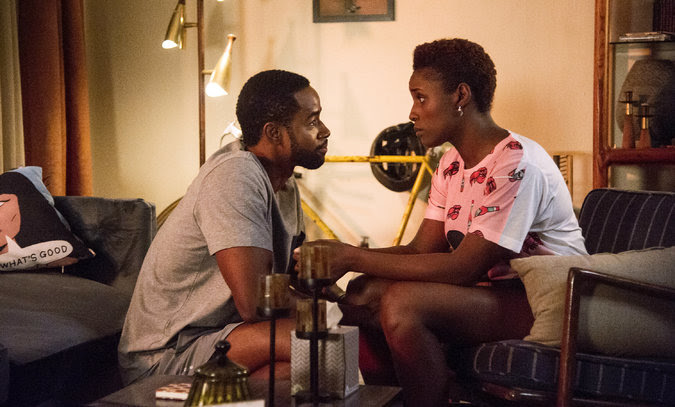
Jay Ellis and Issa Rae in “Insecure.”
As Pop’s presence reminds us, while Dre’s parents worked hard to provide him with an education, Dre did not inherit wealth, making his upper-middle-class status both new and fragile.
This is a legitimate worry because more and more members of the African-American middle class are finding themselves in an economic downslide, with little hope that the next generation will earn more than the one before. In 2015, the Pew Research Center released a report detailing that the number of American households earning a middle-class income had reached its lowest point in over 40 years. And the gap between the wealth of white and Black families has widened to its highest level since 1989, according to a Pew report from 2014.
Black male children raised in middle-class households in the late 1970s and early ’80shave fallen out of the middle class at particularly higher rates than white male children after becoming adults, another Pew report found.
On shows like Donald Glover’s“Atlanta” on FXand Issa Rae’s “Insecure” on HBO, both about a group of late-20-somethings professionally striving and financially struggling (and both, along with “black-ish,” nominated for Golden Globes), the theme of Black downward mobility is put into high relief.
From left, Tracee Ellis Ross, Laurence Fishburne, Miles Brown, Marsai Martin and Anthony Anderson in“black-ish.”
“Comedy in the Black community is almost always about struggle,” said Mary Pattillo, author of “Black Picket Fences: Privilege and Peril Among the Black Middle Class.”“And while exploring class differences is not new for Black sitcoms, it is important that these themes are reproduced and restaged for each generation. The specifics might be different, but every generation returns to this theme because the precarity of the black middle class has not disappeared.”
On“Atlanta,” we meet Earn, a Princeton dropout who grew up in a middle-class family and who works at an airport kiosk. He quits that job to manage his cousin, an up-and-coming rapper named Alfred Miles, known as Paper Boi (Brian Tyree Henry), who has a song on the radio but makes a living as a drug dealer.Earn’s economic instability is exacerbated when his on-and-off girlfriend and his daughter’s mother, Van (Zazie Beetz), loses her job as an elementary schoolteacher because it was the only constant source of income for the family.
“‘Atlanta’ offers up a realistic portrait of the vulnerability that the Black middle class faces today,” said Jessica S. Welburn, a sociologist at the University of Iowa who researchesAfrican-American downward mobility.“While the election of the first African-American president gives many a sense of progress, racial disparities have also intensified and limited what has typically been a pathway to the middle class for African-Americans, like a college degree or a government job. Knowing this, African-Americans still try to break through these barriers with obviously mixed results.”
“The Jacket,” the season finale of “Atlanta,” offers up one of the most pointed critiques of structural racism that I have seen on television this year:Neither Earn’s middle-class childhood nor his Princeton education can protect him from the constraints that he and his friends find themselves under.After Earn wakes up in a strange house in a strange bed without his jacket, we follow him on an increasingly desperate search in increasingly dangerous situations. He finally arrives outside the home of the Uber driver who has his jacket, only to witness him being shot by the police.
From left, Ralph Carter, Jimmie Walker, Esther Rolle and Bern Nadette Stanis in“Good Times.”
As extraordinary as that trauma might be for most Americans, the show portrays the sort of everyday violence to which African-Americans and Latinos, of various classes, are vulnerable.
If race is intimately tied to class, so is gender, as Ms. Rae’s “Insecure” so poignantly reminds us. The main conflict on the series is its female protagonists, Issa and her best friend, Molly (Yvonne Orji), navigating the muddy waters of millennial dating. We first meet Issa, who works at a nonprofit, and her live-in, long-term boyfriend, Lawrence (Jay Ellis), on shaky ground. Despite his Georgetown degree, Lawrence is an entrepreneur unable to finalize his business plan or find a corporate job. He settles on working at Best Buy, and later, with encouragement from Issa, sets aside his dream of developing an app to take a gig at a tech start-up. And while the season concludes with a cheating-related breakup, their relationship was perhaps doomed from the beginning, by his inertia, his unemployment and their economic insecurity.
Through Molly, a lawyer who brilliantly code-switches between corporate and colloquial vernacular, the show explores how class mobility often differs for African-American women and men.
After a string of disappointing romantic encounters, Molly ends up dating Jared (Langston Kerman), a witty, caring guy whom Issa jokingly calls “Rent-a-Boo” because he works at Enterprise.Molly ends their relationship (the first of two times) after she and her friends find out he did not attend college.
GDW NOTE: [Another stereotype that every brother that does not attend college is not intelligent - and that "blue collar workers" are to be looked down upon. There are some Black men out there who are far and above those with degrees - It's our own internal discrimination.]
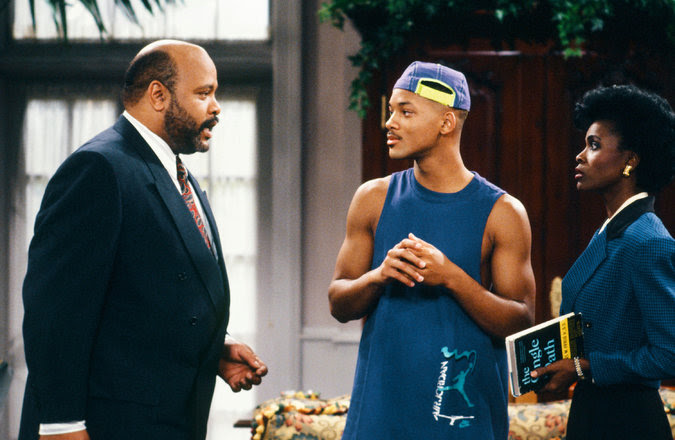
From left, James Avery, Will Smith and Janet Hubert in “The Fresh Prince of Bel-Air.”
Averil Y. Clarke, author of “Inequalities of Love: College-Educated Black Women and the Barriers to Romance and Family,” said: “Middle-class Black women are plagued by a very common racial problem. They, like most women, are encouraged to pursue the middle-class script: Go to college, get a good job and get married and have kids.”She added,“But, when it comes to dating, Black women’s class aspirations are more likely to be unfulfilled than white women, their femininity and sense of value more likely to feel under assault.”
Historically, whether it was the striving of “The Jeffersons” or “The Fresh Prince of Bel-Air” or the working-class settings of shows like “Sanford and Son,” “Roc” or “Thea,” class differences have dominated Black sitcoms in the post-civil-rights era.
That these three recent shows are all created by African-Americans (Kenya Barris created “black-ish”) might enable them to attend differently to these nuances of African-American lives.
Ms. Rae said in an interview with Vox, “This isn’t a show exclusively about, like, the struggle of being Black.”Instead, “It’s just regular black people living life.”By setting her show in South Los Angeles, she is able to reveal the spectrum of African-American class diversity, as she noted in an interview with The Daily Beast: “Yes, there’s poverty there, there are gang members there, but there’s also affluence, there’s middle class, and everybody meshes together.”
Likewise, Mr. Glover said in an interview with Vulture, “I wanted to show white people, you don’t know everything about Black culture.”In that same interview, he underscores that one key difference is how he depicts class diversity. When Mr. Glover heard a suggestion that Paper Boi live in a run-down, “traplike” home, he refused. “We were like: ‘No, he’s a drug dealer, he makes enough money to live in a regular apartment.’” He added, “There were some things so subtle and Black that people had no idea what we were talking about.”
Taken together, these sitcoms remind us of the centrality of race, not just to our conversations but to policies around income inequality. That the coming years may yield a hiring freeze on the federal work force, the continuing decline of unions, and more suffering for both middle-class and working-class African-Americans is no laughing matter. But, as the adage goes: Sometimes we simply have to laugh to keep from crying.
Salamishah Tilletis an associate professor of English and Africana studies at the University of Pennsylvania. She is a co-founder of the nonprofit A Long Walk Home.
As you can see, there are a lot of things we have to be cognizant of, if we are not going to allow ourselves to fall in the pit they (and to some extent we've) already dug for us.
I know you've heard me say this before, but it bears repeating until we finally get up off of it and begin doing it - we have some great leaders in the past, as well as some contemporary ones, who have been in the throes of and forefront of working to bring about Black economic autonomy - Marcus Garavey was and is still relevant - his methodologies are still applicable and well worth studying. Likewise, The Rev. Jesse Jackson has long been a proponent of economic parity and autonomy. His 20th Anniversary of the Rainbow PUSH Wallstreet Project is coming up in February - but he and his staff diligently work throughout the year trying to inform and implement information and programs that African Americans can utilize to first level the playing field, and then start a whole new game.
If nothing else, susu and other forms of economic consolidation have been used throughout the Caribbean communities to underwrite finances when local banks would not. There are so many ways that we can become our own salvation and then we can sit back, look at those sitcoms and laugh because they are funny to watch - but are not who we are any more.
NOW THAT YOU KNOW, WHAT ARE YOU GOING TO DO ABOUT IT?